Facts
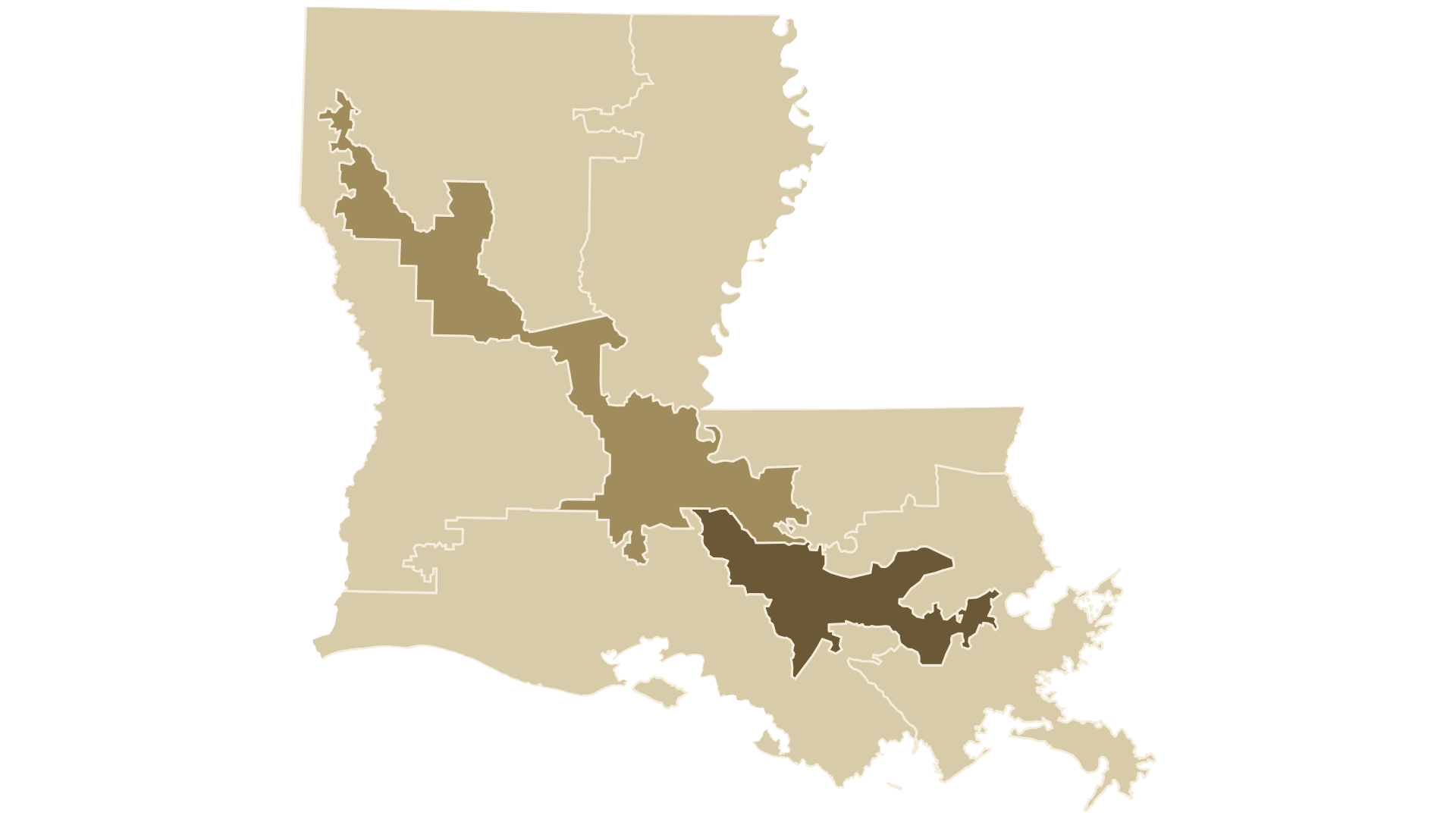
To help explain this topic, we will use Louisiana’s U.S. House districts as a running example. The state’s experience from 2022 to 2026 illustrates much of what is at stake in disputes over race and redistricting. Such disputes can also involve state legislative districts, and they can arise elsewhere in the country and with different racial groups, such as Hispanic voters in California.
-
Louisiana has six seats in the U.S. House of Representatives, and about a third of its residents are Black.1 Each seat belongs to a district, a geographic area whose voters elect one representative. Every ten years, after the census, states redraw these district lines. States sometimes redraw between censuses, by choice or court order. As in most states, Louisiana’s legislature does the drawing.
-
After the 2020 census, the legislature drew a map with one district in which Black voters were a majority. Black voters sued, arguing the legislature could have drawn a second majority-Black district but instead split Black voters across other districts.2 They claimed this “vote dilution” effectively prevented Louisiana’s Black voters from electing a second candidate of their choice.
-
A federal court said the map likely violated Section 2 of the Voting Rights Act.3 Section 2 prohibits district maps and other election practices that give minority voters less opportunity than other voters to participate in the political process and elect representatives of their choice. Originally passed in 1965, the Act came in response to decades of discrimination that had denied Black citizens the ballot and, where they could vote, diluted their influence.4
-
To reach that conclusion, the court applied conditions the Supreme Court had set for vote-dilution claims. Under Thornburg v. Gingles (1986), challengers had to show that the minority group was large and compact enough to form a majority in a reasonably drawn district, that it voted cohesively, and that the white majority usually voted as a bloc to defeat its preferred candidates. Courts then weighed the totality of the circumstances.5
-
In response to the federal court ruling, the Louisiana legislature drew a second majority-Black district. The new district ran diagonally across the state, roughly 250 miles from Shreveport to Baton Rouge, gathering several geographically distinct Black communities. Instead of choosing a more compact shape that would still have been majority-Black, the Republican-controlled legislature said it chose the unusual shape to protect certain Republican incumbents’ districts.6
-
The new map was immediately challenged by a group of non-Black voters. Since Shaw v. Reno (1993), the Supreme Court has held that a district in which race predominates is subject to “strict scrutiny”: the state must show a compelling justification and use race no more than necessary to achieve the purpose, even when seeking to comply with the Voting Rights Act.7 States have thus faced competing risks: too little attention to race could violate the Act, while too much could violate the Constitution. The challengers argued that race had predominated in drawing the new district and that Section 2 did not require a second majority-Black district in the first place. In April 2024, a three-judge panel agreed that Louisiana had gone too far in using race.8 That ruling was appealed to the Supreme Court, which allowed the new map to be used for the 2024 election while the appeals process played out. Louisiana then elected a second Black representative under the challenged map.9
-
In April 2026 the Supreme Court struck down the new map in a 6–3 decision that narrowed how Section 2 applies to vote-dilution claims.10 In Louisiana v. Callais, the Court held that the Voting Rights Act had not required a second majority-Black district. In reaching that conclusion, the Court changed the long-standing legal framework courts had used for Section 2 vote-dilution claims, adding requirements that make it harder for minority voters to show that a district map violates the Act.11
-
In May 2026, Louisiana passed a new map that eliminated its second majority-Black district. Republican legislators said the new map was created based on the partisan goal of flipping a currently Democratic seat to Republican, not with a focus on racial impact.12
-
The Court’s decision does not settle the underlying policy question. Congress can further amend the Voting Rights Act, but under Callais the Constitution limits how far Congress can require states to consider race when drawing district lines.13 The current situation therefore reflects one answer to a continuing question: how far should the government go in considering race when district lines are drawn?
Factors to Consider
Below are three factors to consider, representing different aspects of whether Callais was rightly decided and what future law should be. Each factor has arguments from supporters and opponents of race-conscious redistricting. At the end of this guide, Appendix: Editorial Choices lists other factors and arguments we did not include in this main section with explanations why.
1. Intent versus Outcomes
For several decades before 2026, if a Section 2 challenge met the Gingles conditions, a map could violate the Act based on its outcome—diluting minority voters’ ability to elect candidates of their choice—without proof of discriminatory intent. After Callais, that is no longer enough. Challengers must now present strong evidence that intentional racial discrimination, rather than ordinary politics, is why the map came out as it did.14
It’s difficult to untangle racial discrimination from ordinary politics in a place like Louisiana, where Black voters overwhelmingly favor the Democratic Party, and white voters mostly favor the Republican Party. Because of this alignment of race and party, a map that favors or disfavors Black voters can almost always have a partisan explanation alongside a racial one.
Supporters of race-conscious redistricting argue that outcomes, not intent, call for a remedy. They say that discriminatory intent does not normally announce itself, and especially after Callais, racial discrimination can easily be passed off as partisanship. In their view, the lost political voice is the same either way, and that loss is what the Voting Rights Act was meant to address. They argue that the Gingles test was already a reasonable safeguard against claims based on outcomes alone, and that Callais changed it to be unreasonably hard to meet.15 They point especially to a new requirement that plaintiffs draw an alternative map that creates a majority-minority district while also satisfying the state’s own political goals. Because the state defines those goals, they say, it can define them so that no such map is possible.16 As a result, supporters of race-conscious redistricting consider Callais wrongly decided, and they warn that Louisiana’s second majority-Black district is only the first casualty. They note that other Republican-led states in the South have already begun redrawing maps to eliminate majority-minority districts.17
Opponents argue that Congress and prior court rulings overstepped by asserting that unequal racial outcomes could, without strong evidence of intentional discrimination, justify racial remedies.18 In their view, when Louisiana’s legislature declined to draw a second majority-Black district in the original map, the outcome was unequal but also readily explainable by ordinary partisan politics: the Republicans did not want to create a district that would almost certainly vote Democratic. Absent strong evidence that intentional racial discrimination occurred, opponents argue that requiring a second majority-Black district was not only unnecessary but wrongly injected courts into redistricting politics that were primarily partisan, not racial.19 Opponents defend the new Callais requirements on the same ground: a map that shows an additional majority-minority district is drawable does not by itself show that race, rather than ordinary politics, is why the state didn’t draw it; what separates the two explanations is a map that includes the additional district while also meeting the state’s political goals.
What else to know: Anti-discrimination laws often carry a tension between preventing under-representation and avoiding racial quotas. As amended in 1982, the Voting Rights Act reflected this tension: a map could be judged by its outcomes, but no group was entitled to representation in proportion to its population.20 Callais narrowed the outcomes test greatly. The disclaimer against proportional representation remains.
The key question: When a map leaves a large bloc of minority voters without a realistic opportunity to elect a candidate of choice, should the law treat that outcome itself as the wrong, or should it require strong evidence that race, rather than ordinary politics, explains the map?
2. Race-Conscious Remedies
The previous factor was about what should trigger a remedy for vote dilution. If a remedy is necessary, another problem arises: what should the remedy be? An obvious answer is to draw the district that was missing, but that means sorting voters by race, which the Constitution normally forbids.
Supporters of race-conscious redistricting argue that using race to remedy discrimination is fundamentally different from using race to discriminate in the first place. They reject the idea that a state caught diluting Black votes may respond only by redrawing via the normal process, just without intentional discrimination. In their view, this invites a different route to the same place: under-representation for a large minority bloc that could easily form a majority-minority district. Supporters say the remedy should deliver what was denied—the majority-minority district that minority voters could have formed—using race for that purpose and no other.
Opponents argue that race should play at most a limited role even when a remedy is warranted. Some hold that the government should never assign citizens to districts by race. Others accept the use of race to undo proven, intentional discrimination, but they reject aiming for a particular racial makeup in a district, or a set number of majority-minority districts, as an end in itself. Either way, the goal is to undo purposeful discrimination, not to answer it with discrimination of the state’s own. More generally, opponents believe sorting citizens by race wrongly tells Black voters that race is their political category and makes their representative answerable to a racial constituency rather than a geographic one.
What else to know: Underlying this factor is a disagreement about what should be fixed: the under-representation of a minority bloc large enough to form its own majority-minority district, or only the racial discrimination that tainted how the map was drawn. That question is related to the previous factor’s intent-versus-outcomes debate, but it is not the same. Two people might agree that a remedy requires proof of intentional discrimination, yet disagree about what the remedy should be.
The key question: When intentional racial discrimination is established, should the remedy ensure that minority voters get the majority-minority district they were denied, or should it remove the discrimination without requiring a particular racial makeup?
3. Changed Conditions
When the Voting Rights Act passed in 1965, Louisiana had been among the states with a history of using poll taxes, literacy tests, and registrars’ discretion to keep Black citizens off the rolls, and no Black Louisianan had served in Congress in nearly ninety years.21 Against conditions like those, it was reasonable for a law to assume the worst about a map that left Black voters unable to elect anyone.
More than sixty years later, the electoral conditions in Louisiana and other states are very different, but what that means for voting rights is disputed.
Supporters of race-conscious redistricting acknowledge solid gains in individuals’ ability to freely register and vote, but they argue that progress against vote dilution is at risk. They note that since the Voting Rights Act passed, Black voters in Louisiana have elected representatives of their choice to the U.S. House only from majority-Black districts drawn to comply with the Act.22 They emphasize this is a present-day fact, not ancient history. In their view, outcome-based protections are what led to better Black representation,23 and their absence will reverse that trend—Louisiana’s second majority-Black district was drawn under those protections and disappeared within a month of their removal. Supporters often invoke Justice Ginsburg’s dissent when the Supreme Court undercut another part of the Act in 2013: lessening protections is like “throwing away your umbrella in a rainstorm because you are not getting wet.”24
Opponents acknowledge that in 1965, certain states had earned deep distrust. Sixty years on, they say, a law meant to address discrimination must do so in light of current conditions rather than those that prompted it. Unlike before, they note, Black citizens vote at broadly similar levels to white citizens in Louisiana.25 Opponents add that in the decades after 1965, Black and white Southerners were mostly in the Democratic party, so an unequal outcome had no partisan explanation; today the two parties divide sharply along racial lines, which in opponents’ view is the far likelier cause of unequal outcomes now. Given conditions this different, they argue, the law should not treat a present-day disparity as a continuation of the distant past that all sides have rejected. In their view, the greater risk is overcorrecting for the problems of the past by making the sorting of voters by race a routine feature of how districts are drawn today.
The key question: Do changed conditions justify requiring evidence of intentional discrimination, or would that leave minority voters with too little protection against vote dilution?
Example Viewpoints
The questions above represent genuine tensions without easy answers. Below are examples of how different people might weigh these and other considerations to arrive at coherent positions. You might find yourself aligning with one of these viewpoints, or you might form your own opinion by combining elements from multiple of them.
Fair Outcomes Advocate
In Louisiana, the Voting Rights Act enabled two majority-Black districts in 2024. This allowed Black voters to elect candidates of their choice, providing representation that had long been denied. When the Supreme Court made such districts harder to justify in 2026, one of the two was gone within a month. Saying partisanship, not race, was the cause is a poor excuse. The two are so entangled that majority-Black districts across the South can now be eliminated due to “partisanship.” Under these conditions, it shouldn’t be the excluded voters’ burden to prove discrimination when it’s hidden or latent, or to draw alternative maps while honoring the state’s partisan priorities that caused the exclusion. Instead, maps should use race where necessary to correct exclusion, which is categorically different from using race to exclude in the first place. In sum, outcomes matter, especially avoiding the profoundly unfair outcome of returning to a time when Black voters are under-represented—or unrepresented—for supposedly “race-neutral” reasons.
Representation Pragmatist
In 1965, it made sense to assume racial discrimination was a major cause of long-standing, unequal outcomes in redistricting. More than sixty years later, it’s not so simple. Large minority voting blocs have significant representation. Where that representation is at risk, partisan politics often explains the situation: after the Callais ruling, Louisiana’s Republican-controlled legislature eliminated the state’s second majority-Black district to flip the seat from Democratic to Republican. Other states have done likewise, and more are expected to follow. I can accept a certain amount of this as ordinary politics. But no matter what the cause, if states like Louisiana end up with zero majority-Black districts, or larger states end up with greatly reduced minority representation, then something has gone wrong. Race-conscious redistricting needs to be available to maintain a floor, with ordinary politics operating above it.
Color-Blind Constitutionalist
The government should not sort citizens by race—not to harm them, not to help them. In redistricting, moving voters across a line because of their skin color says race is their political identity. That is not what America should be about. In today’s world, inferring racism from unequal outcomes is wrong when there are other explanations readily available. Only when there is strong evidence of current racial discrimination should race matter to redistricting. In that case, the discrimination should be stopped; it should not be answered with discrimination of the state’s own. I accept where that leads. In a time when legislatures across the country are actively redrawing maps for partisan purposes, a state like Louisiana could conceivably end up with zero majority-Black districts. But that would be a partisan outcome, not the result of intentional racial discrimination. The right to vote is not the right to win.
Deciding
The debate about race and redistricting mixes questions about representation, discrimination, equal treatment, and the weight of history. It’s no surprise that reasonable people reach different conclusions. Our goal has been to give you the facts, arguments, and a range of viewpoints to help inform your own thinking. What you decide is up to you.
(If you are wondering about something we didn’t mention, check the Editorial Choices section below. It includes other aspects of the debate we didn’t include in the main content, with explanations why.)
Appendix: Editorial Choices
In writing this guide, there were many choices to make—for example, how to frame the issue, which factors, arguments, and viewpoints to include, and how to phrase them. For those interested, below are notable choices. You can quickly scan the topics, clicking any for details.
Naming and Framing
We named this guide “Race and Redistricting” because it’s a straightforward, neutral descriptor. We used the Callais case as our running example because it exemplifies the issues at stake and is also the controlling recent decision.
Regarding the label of arguments, we are mindful that supporters generally prefer the term “race-conscious redistricting,” and opponents generally prefer the term “race-based redistricting.” There is no equally concise neutral term. That said, “race-based” suggests that race is the determining factor in how the lines are drawn, which is itself one of the contested questions; “race-conscious” leaves that open. So we labeled the arguments “Supporters of race-conscious redistricting argue…” and, simply, “Opponents argue….” This pairing makes clear what opponents are opposing without adopting supporters’ terminology as the opponents’ label.
Partisan Gerrymandering As Its Own Problem
Gerrymandering is the drawing of district lines to favor candidates of a particular group at the expense of other groups:
- Racial gerrymandering occurs when race predominates in drawing a district map. Such maps are subject to strict constitutional scrutiny and can only survive if a state shows a compelling interest.
- Partisan gerrymandering involves helping or hurting political parties. In most states, it is legal and accepted as ordinary politics: if a legislature is controlled by a party, that party may draw maps to favor its interests. In Rucho v. Common Cause (2019), the Supreme Court held that partisan-gerrymandering claims generally cannot be decided by federal courts because they present political questions rather than judicially manageable legal claims.26
In the guide’s main content, we covered the entanglement of race and party, where one type of gerrymandering can be hard to distinguish from the other. Here we address an additional point: many people regard partisan gerrymandering as a serious problem in its own right, whatever its racial effects. They say that eliminating partisan gerrymandering would reduce confusion about whether district lines were drawn for partisan or racial purposes.
The observation has intuitive appeal, but we have left it to the appendix for two reasons:
-
Partisan gerrymandering is a separate reform question. States can restrict partisan gerrymandering through their own laws and constitutions, such as by establishing independent redistricting commissions. Congress also has authority to regulate congressional redistricting. Whether and how to adopt those reforms is an important debate, but it is broader than the question addressed in this guide.
-
Eliminating partisan gerrymandering would not solve the central disagreement over race and redistricting. Even an independent redistricting commission must decide which principles to use in drawing districts. Supporters of race-conscious redistricting argue that protecting racial minorities’ opportunity to elect preferred candidates should be a top principle; opponents argue that districts should be drawn by traditional criteria alone, accepting whatever racial distribution results. Thus, even “neutral” redistricting requires a decision about what neutrality means and what role, if any, race should play in defining a map.
Congress and Callais
Congress can still amend the Voting Rights Act, but Callais makes that harder than the last time a similar dispute arose. In City of Mobile v. Bolden (1980), a plurality of the Court read Section 2 to require proof of discriminatory purpose.27 Congress disagreed, and in 1982 rewrote Section 2 so that a violation no longer required proof of intent. The House first passed a version that would have judged election practices by their results alone, but it met stiff resistance in the Senate. The enacted compromise, built on language proposed by Senator Bob Dole, kept the results test but defined a violation in terms drawn from earlier vote-dilution cases: under the totality of circumstances, members of a racial group have less opportunity than other voters to participate in the political process and to elect representatives of their choice. It also disclaimed any right to proportional representation.28
Congress was able to change Bolden’s interpretation of Section 2 because that part of the decision concerned a statute, which Congress could amend. Callais is different. The Court presented its reading of Section 2 as the best reading of the text, but also as one the Constitution requires: a broader reading would exceed Congress’ power to enforce the Fifteenth Amendment—a limit Congress cannot simply override with a vote. The Court asserted that the Fifteenth Amendment has long been understood to bar only intentional discrimination in voting. Thus, a law banning racially unequal results regardless of intent would not be enforcing that Amendment; it would be changing it, which is beyond Congress’ power.29
The effect of this was to preclude Congress from overriding Callais like it did Bolden. However, Congress could still work at the margins to help plaintiffs make their Section 2 cases—for example, by clarifying what evidence courts should consider in vote-dilution cases. But Congress is now operating within a framework that makes those cases harder to win than before.
Alternatives to Majority-Minority Districts
Political scientists have debated whether majority-minority districts are necessarily the best way to maximize the political representation of minorities.30 For example, in a situation like Louisiana’s, is it best to have majority-Black districts, or might Black voters have greater influence overall if large but minority blocs were spread among more districts? In favorable circumstances, those voters could join with like-minded non-Black voters to elect candidates responsive to their interests in more districts. The result could be greater substantive representation of Black preferences, even if fewer Black representatives were elected.31
Whether this would work depends on circumstances of time and place, and is subject to uncertainties. We did not cover it in the guide’s main content because the first Gingles precondition for a Section 2 redistricting claim requires that a geographically compact, majority-minority district be possible.32 As well, the arguments and viewpoints in the main content would remain even if the goal were instead a sub-majority district at some particular threshold.
Further Reading
The arguments summarized in this guide were informed by a range of writings and research about race and redistricting. A web search will return many articles freely available online, usually taking one side or the other.
For readers who want to go deeper with a book that maintains a fair-minded perspective, we recommend Race and Redistricting: The Shaw-Cromartie Cases by Tinsley E. Yarbrough. It covers disputes within North Carolina around a 160-mile, snake-shaped district, leading to multiple Supreme Court cases from 1993 to 2001. Although the legal context is different from the post-Callais era, many of the underlying arguments and political tensions are the same. It also provides a close-up view of the people behind the litigation—their motivations, strategies, and experiences—as the cases unfolded.
Acknowledgments
Thanks to:
-
Avi Konduri for research assistance and input.
-
This guide’s reviewers, who brought a range of perspectives and valuable feedback.
They made this guide far better than we could have alone. Responsibility for the guide’s content rests with Fairmind.
(More about this guide’s review process)
Footnotes
-
As of July 2025, U.S. Census Bureau estimates show 32.1% of Louisiana’s residents categorized themselves as Black without additional racial categories. (QuickFacts: Louisiana, U.S. Census Bureau, accessed October 16, 2026.) ↩
-
The plaintiffs presented several illustrative maps showing different ways a second majority-Black district could be drawn compliant with traditional redistricting standards. (Robinson v. Ardoin, 605 F. Supp. 3d 759, U.S. District Court for the Middle District of Louisiana, June 6, 2022.) ↩
-
The court granted a preliminary injunction, finding the plaintiffs likely to succeed on their Voting Rights Act claim. (Robinson v. Ardoin, 605 F. Supp. 3d 759, U.S. District Court for the Middle District of Louisiana, June 6, 2022.) ↩
-
Voting Rights Act (1965), U.S. National Archives, updated February 8, 2022. ↩
-
Thornburg v. Gingles, 478 U.S. 30, Supreme Court of the United States, June 30, 1986. See also Allen v. Milligan, 599 U.S. 1, Supreme Court of the United States, June 8, 2023. ↩
-
Piper Hutchinson, Graves to Lose U.S. House Seat under Louisiana Redistricting Plan That Adds Minority Seat, Louisiana Illuminator, January 19, 2024. See also a map of the added Black-majority district, District 6 of 2024: Louisiana’s 6th Congressional District, map, Ballotpedia, accessed October 16, 2026. ↩
-
Shaw held that race-based districting is subject to strict scrutiny; Miller v. Johnson (1995) clarified that the test is whether race was the predominant factor in drawing a district. (Shaw v. Reno, 509 U.S. 630, Supreme Court of the United States, June 28, 1993; Miller v. Johnson, 515 U.S. 900, Supreme Court of the United States, June 29, 1995.) ↩
-
In the case, a divided panel found that race had improperly predominated over other considerations in drawing District 6, noting that it stretched roughly 250 miles from Shreveport to Baton Rouge and cut through metropolitan areas to gather pockets of Black population from Shreveport, Alexandria, Lafayette, and Baton Rouge. By 2–1, the panel held the map unconstitutional and barred the state from using it in future elections. (Callais v. Landry, 732 F. Supp. 3d 574, U.S. District Court for the Western District of Louisiana, April 30, 2024.) ↩
-
Greg Hilburn, Democrats Gain House Seat in Louisiana with New Majority Black 6th Congressional District, Shreveport Times, November 5, 2024. ↩
-
The Court held that because the Voting Rights Act did not require Louisiana to create an additional majority-minority district, no compelling interest justified the state’s use of race in creating Louisiana’s second majority-Black district. (Louisiana v. Callais, No. 24-109, Supreme Court of the United States, April 29, 2026.) ↩
-
The Callais majority described its decision as updating the Gingles framework; the dissent argued that the decision moved Section 2 back to an essentially intent-based standard. (Thornburg v. Gingles, 478 U.S. 30, Supreme Court of the United States, June 30, 1986; Louisiana v. Callais, No. 24-109, Supreme Court of the United States, April 29, 2026.) See also Allen v. Milligan, 599 U.S. 1, Supreme Court of the United States, June 8, 2023. ↩
-
Jane C. Timm, Louisiana Passes New Congressional Map, Dismantling One Majority-Black District, NBC News, May 29, 2026. ↩
-
Under Editorial Choices, Congress and Callais explains why a congressional override of Callais will not be as straightforward as the 1982 amendment that overrode another Court opinion on the Voting Rights Act. ↩
-
Louisiana v. Callais, No. 24-109, Supreme Court of the United States, April 29, 2026, slip op. pp. 23–26, 29–30, 35–36. ↩
-
Callais modified the Gingles framework so: (1) illustrative maps may not use race in drawing lines and must satisfy all of the state’s legitimate redistricting objectives, including partisan goals; (2) evidence of racially polarized voting must show a racial pattern that party affiliation cannot explain; and (3) in weighing the totality of circumstances, courts must focus on present-day intentional discrimination, giving much less weight to discrimination from the past or to current disparities characterized as ongoing effects of societal discrimination. (Louisiana v. Callais, No. 24-109, Supreme Court of the United States, April 29, 2026, slip op. pp. 29–31.) ↩
-
For example, if the state says the partisan goal is for every district to be won by a Republican, then that precludes an alternative map with a majority-Black district since that district would likely be won by a Democrat. Opponents of race-conscious redistricting would say that this is an unavoidable consequence of a state being allowed to seek partisan advantage: a map that forecloses a majority-Black district in pursuit of that advantage is a partisan map, not a racial one. Also, in many states, there are natural limits to eliminating majority-minority districts, especially a single remaining district like Louisiana’s. Unpacking that district’s minority population across other districts would make those other districts more contested, which could lead to Democratic upsets in previously safe Republican areas. ↩
-
Florida, Alabama, and Tennessee were able to change their maps, eliminating a majority-minority district in each state for the November 2026 election. More states are expected to make similar moves that would affect the 2028 elections. (Maggi Lazarus and Matthew E. Morgan, Gerrymander Wars: Outlook for the 2026 Midterm House Elections, National Law Review, August 12, 2026, section “Round Two: Redistricting to Eliminate Majority-Minority Districts.”) ↩
-
Opponents note that the Voting Rights Act is rooted in fulfilling the promise of the Fifteenth Amendment, which bars denying or abridging the right to vote on account of race. They argue this has long been held as a ban on purposeful discrimination, not as an entitlement to equal outcomes, and that the same should apply to the Act. (Reno v. Bossier Parish School Board, 520 U.S. 471, Supreme Court of the United States, May 12, 1997.) In Callais, the Supreme Court largely agreed. (Louisiana v. Callais, No. 24-109, Supreme Court of the United States, April 29, 2026.) ↩
-
Rucho v. Common Cause (2019) held that federal courts cannot decide partisan gerrymandering claims about district maps. (Rucho v. Common Cause, 588 U.S. 684, Supreme Court of the United States, June 27, 2019.) The Partisan Gerrymandering As Its Own Problem section in Editorial Choices explains this aspect of the debate further. ↩
-
The 1982 amendment rewrote Section 2 of the Voting Rights Act to bar practices that result in unequal opportunity to elect representatives of one’s choice, without requiring proof of a specific discriminatory intent. It also added a sentence disclaiming any group’s right to be elected in numbers equal to its proportion of the population. (Voting Rights Act Amendments of 1982, Pub. L. No. 97-205, § 3, 96 Stat. 131, 134 (codified as amended at 52 U.S.C. § 10301).) Congress acted after a plurality of the Court concluded in City of Mobile v. Bolden that Section 2 had no effect different from the Fifteenth Amendment and required discriminatory purpose. (City of Mobile v. Bolden, 446 U.S. 55, Supreme Court of the United States, April 22, 1980.) ↩
-
Charles E. Nash, elected in 1874, was the first Black member of Congress from Louisiana. The state sent no other until William Jefferson took office in 1991. (Charles Edmund Nash, in Black Americans in Congress, 1870–2007, H. Doc. 108-224, Government Printing Office, 2008, pp. 134–137.) ↩
-
In the case that led to creating Louisiana’s second majority-Black district, a federal court found that voting in Louisiana is starkly polarized by race, and that outside majority-Black districts, white voters have consistently voted as a bloc to defeat the candidates Black voters prefer. (Robinson v. Ardoin, 605 F. Supp. 3d 759, U.S. District Court for the Middle District of Louisiana, June 6, 2022, pp. 839–844.) ↩
-
Louisiana’s congressional maps included no majority-Black district until the 1980s. During the 1981 redistricting, Black legislators argued that a majority-Black district in the New Orleans area was necessary for Black voters to elect a representative of their choice, but the legislature adopted a plan without one. In 1983, a three-judge federal court held that the plan violated the Voting Rights Act. (Major v. Treen, 574 F. Supp. 325, U.S. District Court for the Eastern District of Louisiana, September 23, 1983.) The state responded by adjusting the lines of its New Orleans–based 2nd District so that Black voters would constitute a majority. Notably, the district continued to elect its white incumbent, Lindy Boggs, in 1984, 1986, and 1988, with significant Black support. (Boggs, Corinne Claiborne (Lindy), History, Art & Archives, U.S. House of Representatives, accessed October 16, 2026.) When she retired in 1990, the district elected William Jefferson, its first Black representative. (Jefferson, William Jennings, History, Art & Archives, U.S. House of Representatives, accessed October 16, 2026.) ↩
-
Shelby County v. Holder, 570 U.S. 529, Supreme Court of the United States, June 25, 2013 (Ginsburg, J., dissenting). ↩
-
In Louisiana, turnout of Black and white voters varies by election. For the November elections from 2014 to 2024, Black voters had higher turnout than white voters in 2014, 2016, and 2022, and lower turnout in 2018, 2020, and 2024. (Voting and Voter Registration as a Share of the Voter Population, by Race/Ethnicity, KFF, accessed August 26, 2026.) ↩
-
Rucho v. Common Cause, 588 U.S. 684, Supreme Court of the United States, June 27, 2019. ↩
-
City of Mobile v. Bolden, 446 U.S. 55, Supreme Court of the United States, April 22, 1980. ↩
-
Voting Rights Act Amendments of 1982, Pub. L. No. 97-205, § 3, 96 Stat. 131, 134 (codified as amended at 52 U.S.C. § 10301). On the House–Senate compromise: Brnovich v. Democratic National Committee, 594 U.S. 647, Supreme Court of the United States, July 1, 2021, slip op. pp. 5–6. How far the compromise limited the results test remains disputed. In Brnovich, the majority treated whether the political process is “equally open” as the touchstone of Section 2, while the dissent read the provision more broadly. ↩
-
Louisiana v. Callais, No. 24-109, Supreme Court of the United States, April 29, 2026, slip op. pp. 22–24. ↩
-
Charles Cameron et al., Do Majority-Minority Districts Maximize Substantive Black Representation in Congress? American Political Science Review 90, no. 4 (1996): 794–812. See also David Lublin, Racial Redistricting and African-American Representation: A Critique of “Do Majority-Minority Districts Maximize Substantive Black Representation in Congress?” American Political Science Review 93, no. 1 (1999): 183–186. ↩
-
Carol M. Swain, Black Faces, Black Interests: The Representation of African Americans in Congress, Harvard University Press, 1993; enlarged edition, University Press of America, 2006. ↩
-
Thornburg v. Gingles, 478 U.S. 30, Supreme Court of the United States, June 30, 1986. ↩
Thank you for reading! How likely are you to recommend this guide to a friend interested in the topic?
0 = Not at all likely, 10 = Extremely likely