Facts
To understand the arguments pro and con below, here are a few preliminary facts about carrying a gun in public in the United States:
-
Carrying a gun outside the home is constitutionally protected but can be regulated to some extent. In 2008, the Supreme Court held that the Second Amendment protects an individual right to possess a firearm for lawful purposes such as self-defense in the home.1 In 2022, the Court confirmed that this right generally extends to carrying firearms in public for self-defense.2 The Court emphasized that the right to keep and bear arms is not unlimited and that certain longstanding regulations are permissible if consistent with historical tradition.
-
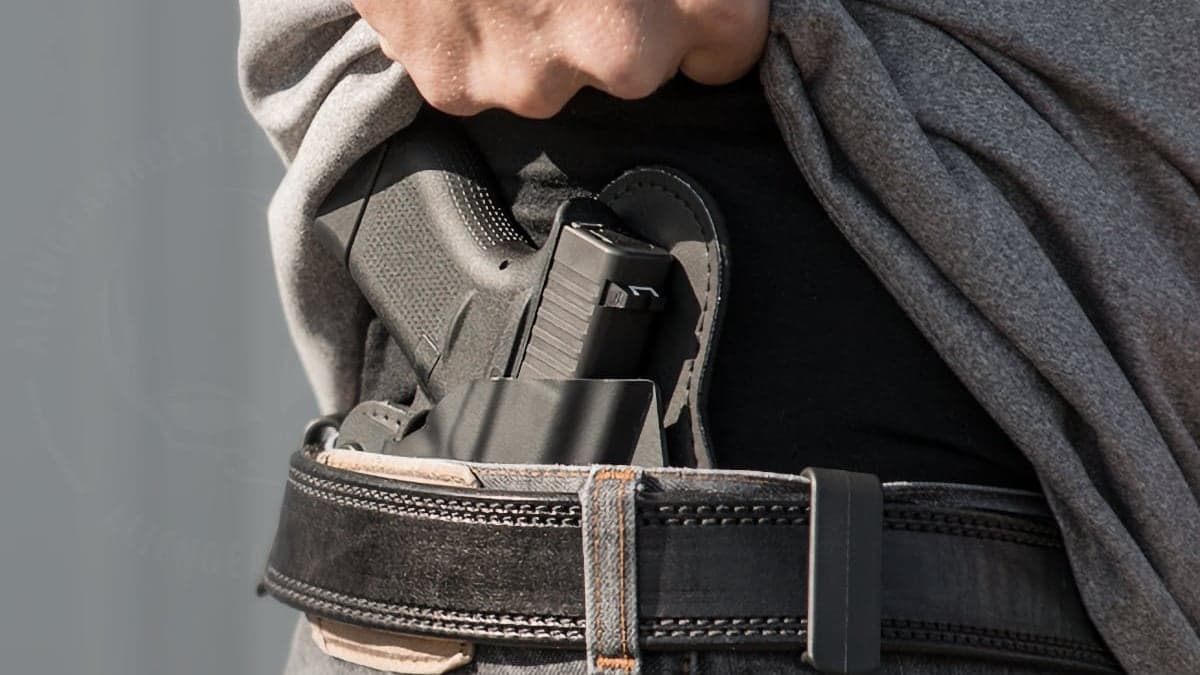
Public carrying for self-defense usually means carrying a concealed handgun. People who carry a gun in public for protection usually carry a handgun that is concealed under clothing or otherwise out of view.3 Concealment allows the firearm to be carried without drawing attention or causing alarm while still making it available for self-defense. As a result, debates about guns in public are most prominently debates about concealed carry laws.
-
States regulate concealed carry in different ways:
-
29 states do not require a permit to carry a concealed firearm. This is known as “permitless carry” or (by its advocates) “constitutional carry.”
-
21 states and Washington, DC, require permits. In almost all cases, a background check and evidence of training is required.4 The type and amount of training varies. Some states have additional requirements such as character references or an in-person interview.5
-
Although there are exceptions, states that require permits tend to be more coastal, northern, and urban, whereas permitless states tend to be more southern or middle-of-country rural.
-
Source: Fairmind / MapChart (map), RAND (data)6
-
12% of American adults (about 32 million people) carry a gun in public at least some of the time. Included in this is 5.6% of American adults (about 15 million people) who carry all or most of the time.7
-
Roughly 10,000 gun homicides occurred in public or semi-public settings in 2023, such as streets, highways, vehicles, transportation hubs, parking lots, and commercial areas. This was roughly half of gun homicides, with the other half occurring in homes, apartments, or other residential environments.8
Factors to Consider
Below are the three main factors to consider about the concealed carrying of guns in public, each with opposing arguments. At the end of this guide, Editorial Choices lists several factors and arguments we did not include in this main section with explanations why.
1. Regulating a Right
A key question in gun debates is how far a constitutional right can be regulated:
Supporters of carry permits argue that concealed carry permits are a sensible way to promote public safety and do not negate gun rights. They note the Supreme Court has approved the type of permits currently in use by states.9 They point to a long tradition of states having concealed carry laws that coexist with gun rights.10 They say the underlying idea has remained consistent: carrying in public puts more people at risk and thus justifies requiring qualifications beyond general gun-ownership laws.
Opponents of carry permits argue that the right to defend oneself with a firearm is fundamental and, because violent crimes can occur anywhere, applies in public as well as at home. Most opponents accept some narrow restrictions—such as prohibitions on felons possessing firearms—but reject permits, fees, and mandatory training as requirements that turn a right into a privilege dependent on permission from the government.
What else to know: Some people compare concealed carry permits to driver’s licenses. They note that all states require training and a license to drive because mistakes can endanger others. They argue carrying a gun in public raises similar concerns. But others say the analogy is flawed because driving is neither a constitutional right nor as fundamental as the right to defend oneself in public.
The key question: Does the potential risk to the public of concealed carry justify requiring a permit, or does that convert a constitutional right into a privilege granted by the government?
2. Effect on Crime
Concealed carry laws could plausibly either reduce or increase crime:
Supporters of carry permits can credibly claim that a recent systematic review of research found that weaker permit laws (including permitless laws) increase violent crime by a small but significant amount (2%–7%).11 The research does not clearly explain why the effect occurs, but supporters often hypothesize that having more guns in public increases the chances that conflicts escalate into deadly encounters. They point to cases like a 2025 road-rage dispute in Arizona where misuse of a gun killed an uninvolved woman in a nearby car.12 In their view, permits—especially those requiring background checks and training—can lessen these kinds of incidents, preventing needless deaths.
Opponents of carry permits respond that academics may argue about small and uncertain effects, but anyone can see that since 2010, more than 25 states have switched from requiring a permit to not requiring a permit.13 They argue that this large, one-way shift would have been unlikely to continue if there were obvious negative effects on crime or policing. They also point out that armed civilians sometimes prevent serious harm. For example, in 2022 at the Greenwood Park Mall in Indiana, a legally armed bystander shot and killed a heavily armed shooter who had already killed three people and could have killed dozens more.14 Opponents add that most defensive uses of a firearm never involve shots fired because a would-be attacker retreats or surrenders upon realizing the target or a bystander is armed.
What else to know: Although each side tends to selectively cite research and examples that support their view, we’ve used the most defensible claims. That said, both sides’ cases have caveats:
-
Research on how carry laws affect crime must separate a law’s effects from several other interacting factors, including economic conditions, policing levels, incarceration rates, demographic changes, and broader national crime trends. The recent systematic review by RAND’s Gun Policy in America project attempted to evaluate studies using consistent criteria for judging reliability,15 but reasonable researchers still disagree about the results. So, conclusions are better understood as directional rather than settled.16
-
The claim that more than 25 states have switched from requiring a permit to not requiring a permit, with none going the other way, is a strong indication of political momentum. However, the absence of obvious negative effects overall does not necessarily mean that changes in permitting policy had no effect. Crime rates are influenced by many factors at the same time, so a small increase or decrease caused by carry laws could be masked by other factors. Also, the states that adopted permitless carry were not random. Most already had less restrictive systems, so removing the permit requirement was a smaller change than it would be in states with stricter laws, such as California or New York.
-
As the Greenwood Park Mall incident dramatically illustrates, defensive gun use is a real phenomenon. However, its effect on crime is already reflected in the 2%–7% crime-effect estimate cited in the supporters’ paragraph.17
The key question: If research suggests that weaker or no permitting may increase violent crime by a small (single-digit percentage) amount, yet states that have switched to permitless carry have not encountered problems clear enough to motivate switching back, should policymakers err on the side of precaution or on the side of avoiding restrictions on a constitutional right?
3. Unequal Burden of Obtaining a Permit
A point of concern involves the cost and time required to get a carry permit. Depending on the state, this can include multiple administrative fees (typically totaling between $50 and $200),18 a separate fee for training, and the time needed to apply, attend classes, and wait for approval.
Supporters of carry permits acknowledge that getting a permit has costs in money and time, and that these costs can burden lower-income people more than others. But they argue the training requirement serves a genuine public-safety purpose that justifies those costs: teaching safe handling, legal rules for use of force, and how to avoid high-stress judgment errors. They also note that many other forms of licensing and regulation have costs to the applicant. They say it would be more of a concern if state laws had clearly excessive fees, long delays, or discretionary standards designed to discourage lawful applicants. They argue that if a state crossed that line, legal action by advocacy groups would almost certainly follow.
Opponents of carry permits argue that permit fees and training costs operate like long-discredited poll taxes, falling hardest on people with lower incomes. They say this is especially troubling for concealed carry because many lower-income individuals live or work in higher-crime areas where the need to exercise the right of self-defense may be greatest. In their view, even modest fees, delays, or procedural requirements can become barriers in practice, making it harder for some people to exercise their right to armed self-defense than others.
The key question: Is the unequal burden of obtaining a permit a serious problem or a manageable consequence of regulation?
Example Viewpoints
The questions above represent genuine tensions without easy answers. Below are examples of how different people might weigh these and other considerations to arrive at coherent positions. You might find yourself aligning with one of these viewpoints, or you might form your own opinion by combining elements from more than one.
You will notice that there is no viewpoint for “No Concealed Carry.” Although some people would prefer that position, it’s not a viable policy under the Supreme Court’s current interpretation of the Constitution, which shows no sign of changing in the foreseeable future.19
Gun Rights Advocate
Law-abiding citizens should not need a permit to carry a concealed firearm in public. The Constitution protects the right to armed self-defense, and that right should apply equally in the home and in public. Requiring a permit effectively turns a right into a privilege dependent on government approval. Because constitutional rights are not supposed to depend on fees, training requirements, or bureaucratic processes, states should not require permits for concealed carry. In the past twenty years, most states have followed this logic, moving from requiring permits to allowing permitless carry. The remaining states should do the same, or Congress should pass a law to make permitless carry the national standard.
Gun Rights Pragmatist
People should have the right to defend themselves with a firearm, including in public. Because that right is important, restrictions should require clear justification. Although there is evidence that weaker permitting laws are associated with slightly higher rates of violent crime, many states have moved to permitless carry without obvious negative consequences for crime or policing. Also, permitless systems avoid concerns that fees and training requirements put an extra burden on lower-income applicants. So given what we know overall, I think states should allow permitless carry unless clearer evidence emerges that doing so causes serious harm.
State-by-State Pragmatist
In my view, concealed carry is a good example of an issue where different states may reasonably adopt different policies. It is not surprising to me that permitless carry may be more acceptable for rural, lower-density states where firearms are culturally familiar. It’s also not surprising that states with less gun culture and more urban density may favor greater regulation. Both approaches fit within America’s long tradition of balancing gun rights with regulation. So instead of advocating for a single answer, such as a federal permitless carry law, I think states should adopt the system that fits their circumstances.
Gun Regulation Pragmatist
I accept the current reality that the Supreme Court has recognized a constitutional right to carry a gun in public for self-defense. But when firearms are carried in shared public spaces, mistakes or poor judgment can endanger others. I realize that many permitless states appear to function without obvious problems, but credible evidence suggests that weaker permitting laws are associated with slightly higher rates of violent crime. Given the large number of gun homicides, even a difference of a few percentage points represents hundreds of lives. So based on what’s known, I believe it’s reasonable to require permits with training. Such permit requirements have long existed in many states. The justification for them continues to make sense today.
Gun Regulation Advocate
Gun rights and regulation have always coexisted for a reason: Guns are uniquely dangerous, even more so in public. I think the Supreme Court has interpreted gun rights too broadly, but even so, the Court has made clear that current permit systems are constitutional. I’d like to see the strongest versions of these systems adopted widely, including rigorous background checks, training that includes time at a gun range, and regular renewals. This is because if civilians are going to carry guns in shared public spaces, the standards for doing so should be high, not minimal.
Deciding
The debate about guns in public mixes questions of rights, safety, freedom, and practical effects. It’s no surprise that reasonable people reach different conclusions. Our goal has been to give you the facts, arguments, and a range of viewpoints to help inform your own thinking. What you decide is up to you.
(If you are wondering about something we didn’t mention, check the Editorial Choices section below. It includes other aspects of the debate we didn’t include in the main content, with explanations why.)
Appendix: Editorial Choices
In writing this guide, there were many choices to make—for example, how to frame the issue, which factors, arguments, and viewpoints to include, and how to phrase them. For those interested, below are notable choices. You can quickly scan the topics, clicking any for details.
Naming and Framing
We recognize that perceptions can be swayed by how a topic is framed and by the terminology used. In this, as with everything else in this guide, our goal is to be fair and accurate.
Overall Framing
In the debate about guns in public, the most prominent point of contention is concealed carry laws. Within that debate, the clearest line of division is between states that require a permit and those that do not. As a result, we framed this guide’s overall question as “Should carrying a concealed firearm in public require a permit?”
Factor Choices
In debates about concealed carry permits, the arguments that tend to determine people’s positions fall under three types of questions:
- As a matter of principle, to what extent can a constitutional right be regulated?
- As a matter of consequences, what are the effects of more versus less regulation?
- As a matter of fairness, do regulations impose problematically unequal burdens on different people?
In essence, these are the three Factors to Consider. The factors provide a structure in which the different sides’ arguments can meet head-on. For a fair-minded reader, this is more helpful than simply seeing a list of each side’s talking points, which usually talk past each other.
For more on Fairmind guides’ structure and authoring principles, see Fairmind Format.
Labels for Supporters and Opponents
We used the terms “supporters of carry permits” and “opponents of carry permits” because they are descriptive and avoid advocate-defined terms like “constitutional carry” (which implies the opposite is unconstitutional carry).
Order of Arguments
Within a Factor to Consider, we present the arguments from one side, then the other. For fairness, it might be best to alternate which side goes first as the factors progress. But having tested that, we found the inconsistent order confused readers. So for this guide, we chose the “supporters or carry permits” side to go first.
The reason is, the guide’s subtitle asks whether carrying a concealed firearm in public should require a permit. It’s natural to hear the case for “yes” before the case for “no”—the side arguing for the proposition goes first, the side arguing against responds.
That said, order is not endorsement. Appearing first in a factor does not mean an argument is stronger, more widely held, or editorially favored.
“Gun” versus “Firearm”
In American usage, “gun” and “firearm” mean essentially the same thing. “Gun” is the more common term. “Firearm” is typically used in legal contexts. In this guide, we mostly use “gun,” especially as an adjective (“gun debate,” “gun culture,” etc.). We use “firearm” in more legalistic contexts, including in the guide’s overall question (“Should carrying a concealed firearm in public require a permit?”), which is about what the law should be.
Advocates as Data Sources
Our preference is to cite data and analyses from neutral sources. But in some cases, we sourced data from organizations connected with advocates on one side or the other of the debate. We did so because they had the best data for the point being made in the text. For example:
-
Under Facts, we have counts of states that do and do not require permits, including a mention that almost every state that requires a permit also requires training. The mention of training is based on data from Everytown Research & Policy, which is part of Everytown, an advocacy organization for gun regulation.
-
Under Effect on Crime, it says more than 25 states switched from requiring a permit to not requiring a permit since 2010. This is based on data from Handgunlaw.us, which is aligned with the gun-rights movement.
In all cases when we used data from an advocate-aligned source, we verified its accuracy and that it was presented fairly.
RAND’s Research
Regarding concealed carry laws’ effect on crime, the nonpartisan research organization RAND is a particularly valuable resource. As part of its Gun Policy in America project, RAND researchers compiled an extensive database of state laws and analyzed decades of studies. We have referenced their work in multiple places.
Some gun-rights advocates have questioned the neutrality of RAND’s work based on some of its funding sources.20 We took that concern seriously, but we did not find evidence that the funding produced selective or distorted treatment of the evidence. In our view, RAND’s research displayed the opposite tendency: extensively documenting its methods, comprehensively assessing studies with different findings, distinguishing stronger from weaker evidence, and frequently communicating uncertainty.
Sensitive Places
A related but separate issue from concealed-carry-permit laws is “sensitive places” laws. They define places where guns cannot be carried (concealed or openly) by civilians:
-
At the federal level, examples include federal buildings, post offices, prisons, and secure airport areas.21
-
At the state level, every state has at least some sensitive places. Near-universal examples include state government buildings (especially courthouses), schools, and polling places. States with longer lists might include bars, hospitals, and public transportation. And states with the most expansive lists might include parks, playgrounds, museums, libraries, casinos, large events, and public demonstrations.22 Some states also include exemptions or additional qualifications for certain locations and circumstances.
After the 2022 Bruen decision, some states that lost the more restrictive aspects of their permitting schemes tried to compensate by adding to their lists of sensitive places.23 Opponents say that if many places end up off-limits, then the right to self-defense is undermined. For example, if public transportation is designated a sensitive place, a person who relies on it to reach work, school, or other destinations may be unable to carry at all in daily life, because they cannot legally carry during the trip needed to get to those places.
We did not include the debate about sensitive places in this guide because the laws are distinct from carry-permit laws, and the arguments are somewhat different. Also, research about the effect of sensitive-places laws on crime is not extensive enough to draw useful conclusions.24
Reciprocity Laws
Reciprocity laws determine whether a concealed carry permit issued by one state is recognized by another. For example, someone with a permit from their home state may or may not be allowed to carry while traveling in other states, depending on those states’ reciprocity rules.
We did not include reciprocity in the main content because it’s about how states’ laws interact with each other. This is distinct from the guide’s main focus: whether states should require a permit for concealed carry within their own borders.
Potential National Permitless Carry Law
Concealed-carry-permit laws have traditionally been handled by states, not the federal government. But in the 2025–2026 Congress, bills were introduced in the House and Senate that would preempt state laws to make permitless carry the standard nationwide.25
We did not include this development in the main content because as of March 2026, neither bill had advanced beyond initial stages, and in prior Congresses, less sweeping proposals have repeatedly failed to become law. For example, the Concealed Carry Reciprocity Act has been introduced in every Congress since 2015 but has never been enacted. The Act would require states to recognize each other’s permitting systems so citizens traveling in one state would still be subject to their home state’s law. This is less of a reach than mandating permitless carry nationwide, and it has not succeeded.
Public Opinion
Supporters of carry permits sometimes cite U.S. public opinion polls that indicate strong opposition to permitless concealed carry. For example, a 2022 poll by the Marquette University Law School found that 81% of Americans opposed permitless concealed carry. That same poll found that 62% of Americans favored concealed carry with a permit.26
While poll results are interesting, we did not include a public-opinion argument in the main content for a few reasons:
-
Public opinion does not determine advocates’ positions. Advocates use polling when it suits their purpose; otherwise they ignore or attack it. If the polling flipped, advocates wouldn’t change their views on concealed carry permits. They’d simply change their views on the relevance of the polling.
-
Public opinion shouldn’t be a primary reason for your own decision. The purpose of a Fairmind guide is to help you think through the substance of an issue for yourself. Letting public opinion decide for you is the opposite of that.
Also, it’s worth noting that most polls on the topic are national, whereas concealed carry laws are decided state by state. Each state’s public opinion will differ from national opinion, making the national results less relevant than they might initially seem.
International Comparisons
Supporters of carry permits sometimes argue that permitless U.S. states are outliers compared to every other western country, all of which require a permit if they allow concealed carry at all.27 They say the U.S. is out of step with the rest of the world, and that other countries’ experience is worth learning from.
Opponents respond that the U.S. has a constitutional gun-rights tradition and a level of gun ownership that other countries lack. They see this situation as a good thing, not a reason to emulate others.
We did not include this angle in the guide’s main content because it’s secondary, and of disputed relevance, to the debate’s key factors to consider.
Background Checks
Supporters of carry permits often note that requiring a permit allows the state to include an electronic background check as one of the conditions. They say this helps flag people with criminal records who legally should not have access to a gun at all.
Although the claim is true, a background check has limited value as part of a carry-permit application process. Most people who would fail a background check will not expose themselves to scrutiny by applying for a carry permit. In addition, many lawful applicants will already have undergone a background check when purchasing a firearm from a licensed dealer.
In comparison, the training requirement for a permit is unique to the permitting process and is usually the greatest burden for lawful applicants. It is also the main feature cited by supporters as the public-safety justification for requiring permits. For these reasons, we focused more on training requirements associated with permits rather than background checks or other less common conditions.
Interest-Group Influence
In debates about concealed carry laws, some critics argue that the spread of permitless carry reflects the influence of organized gun-rights groups, particularly the National Rifle Association, rather than broad public demand. They note that advocacy organizations with politically active members can have a disproportionate impact in state legislatures, driving outcomes independent of public opinion.
Others respond that the shift toward permitless carry has occurred mostly in states where voters and elected officials already hold strong pro-gun views, and that legislative outcomes in those states are consistent with their political cultures. They note that there are advocacy organizations on the other side of these debates, and that competition of interest groups is part of the democratic process.
We did not include this angle in the main text because it is more about how laws are made, not whether permits should be required. Although interest-group influence on legislative outcomes can distort how the public perceives issues like concealed carry, we concluded that whatever distortion may exist is secondary to—not overriding of—the arguments about the merits of concealed carry permits.
“Criminals Won’t Get Permits”
Opponents of carry permits sometimes argue that permits are pointless because criminals won’t get permits. Although it’s broadly true that criminals won’t apply for permits, stopping criminals is not the main point of concealed carry permits. For most current permitting systems, the main point is to require training so people who lawfully carry in public (that is, non-criminals) meet basic standards of competence and responsibility. This helps reduce situations where untrained carriers escalate conflicts or misuse their firearms in ways that endanger themselves, bystanders, or police.
To be clear, people against requiring permits are not against training. They object to government-mandated training. That is a key dispute, and the claim that “criminals won’t get permits” does not address it.
The Cultural Argument Against Permitless Carry
Some supporters of carry permits argue that permitless carry reflects a cultural drift toward a society where problems created by guns are allegedly solved by yet more guns. They ask, regardless of measurable effects, who wants to live in a society organized around that premise?
We did not include this argument in the main content because it is not specific to the permit question. It could just as well apply to any loosening of gun regulations, and its implied remedy goes beyond permitting. So we considered it beyond the scope of this guide.
The narrower, permit-specific version of this concern—that requiring a permit expresses a social norm about responsibility in shared public spaces—is addressed in the main content.
Shall-Issue versus May-Issue Permitting
Until the Supreme Court’s 2022 Bruen decision, an important distinction in concealed carry laws was between “shall-issue” and “may-issue” permitting. A shall-issue system assumes the applicant is entitled to a permit unless disqualified; a may-issue system allows officials to deny a permit unless the applicant shows a special need.
The Court’s decision in Bruen held that discretionary may-issue systems were unconstitutional, effectively eliminating them in their prior form. As a result, the main debate today is not about may-issue versus shall-issue, but about whether permits should be required at all.
For that reason, we did not include the shall-issue / may-issue distinction in the main part of the guide. We mention it here because many older articles and online discussions of concealed carry still use that terminology, so readers are likely to encounter it when researching the issue.
Defensive Gun Use and the Case for Carrying
A common argument in gun-policy debates is the importance of defensive gun use (DGU): the idea that armed civilians can prevent or interrupt violent crimes against themselves or others. Some advocates add that the value of carrying lies partly in the capability itself—having the option to defend oneself in an emergency, whether or not it is ever exercised. In their view, actual DGU incidents and the value of the capability itself together outweigh any potential social costs of concealed carry.
We touched on DGU in Effect on Crime, where the opponents’ paragraph cited the 2022 Greenwood Park Mall incident and noted that most defensive uses never involve shots fired. But we did not develop DGU into a standalone factor in the main content because the broader argument bears more on whether concealed carry should be allowed than whether a permit should be required. Under either a permit or permitless system, qualifying individuals can carry and use a firearm defensively if needed. A permit requirement raises the cost of access through fees and training, but it does not remove the underlying capability. The fairness concern about that added cost is addressed in Unequal Burden of Obtaining a Permit.
Effect on Policing
Both sides of the debate make arguments about the effect of concealed carry permits (or the lack thereof) on policing. For example:
-
Identifying “The Good Guys.” On one hand, a permit allows an officer to know a person has been vetted to carry. On the other hand, the officer usually must first interact with the person to know whether they have a permit, which limits the value of the permit in the initial approach. More generally, police training emphasizes that officers should not assume a person is safe until a situation is secured. This reduces the practical importance of whether a person has a permit.
-
Civilian Gun Training. Almost every police officer would say civilians who carry guns should be properly trained. At the same time, a large majority of police officers support a broad view of gun rights and are reluctant to endorse permit laws for concealed carry, including laws that require training.28 Officers sometimes note that law-abiding carriers already have strong incentives to get training and to act responsibly, and that the main risks to police come from criminals or from people who would not obtain permits anyway.29
-
Endorsements. When states have debated adopting permitless concealed carry, in-state police leaders have been mostly against it, especially in urban areas.30 In some cases, leaders were mixed,31 but we could find no cases where they were fully supportive. (We are referring here to police leaders and groups who made official endorsements, not the general sentiment of rank-and-file officers, which tilts against permits.) National organizations such as the International Association of Chiefs of Police and the Fraternal Order of Police have supported safeguards such as background checks and training where permit systems exist, but they have not taken a consistent position against states that allow permitless carry.32 These groups have, however, opposed some reciprocity proposals that would require states with stricter laws to recognize permits—or lack of permits—from other states.33
Because there isn’t a clear story from the law enforcement world, and it isn’t primary in the debate, we did not include concealed carry laws’ effect on policing in the main section.
The “More Guns, Less Crime” Hypothesis
Gun-rights advocates often cite research by economist John Lott, whose 1998 book More Guns, Less Crime argued that relatively permissive concealed carry laws reduce violent crime by deterring criminals who fear encountering armed victims. Lott has continued publishing in this vein, but independent evaluations of the “more guns, less crime” hypothesis have not been supportive:
-
A 2005 National Academies of Sciences review found the existing research—including Lott’s original work—methodologically insufficient to support conclusions in either direction.34
-
More recently, RAND’s Gun Policy in America project, which has recently conducted a comprehensive review of the concealed carry literature, concluded that the best evidence from newer studies suggests weaker permit laws (including permitless laws) increase violent crime by a small amount.35 That finding informs our treatment of the crime research in Effect on Crime.
The Militia Argument
Some gun-regulation supporters would argue that this entire guide rests on a flawed premise: that the Second Amendment protects an individual right to carry a gun in public. They point to the Amendment’s text: “A well regulated Militia, being necessary to the security of a free State, the right of the people to keep and bear Arms, shall not be infringed.” In their reading, the Amendment was originally understood as a civic right tied to citizens’ participation in a well-regulated militia, rather than as a broad private right of individuals to carry guns for personal purposes. On this view, the historical tradition also left substantial room for government regulation of arms.36
In Heller, the Supreme Court considered this viewpoint and ruled against it. By a narrow majority, the Court held that the historical context of the words pointed to an individual right to keep and bear arms, not just for militia service.37 In Bruen, the Court confirmed that the right applied to carrying a firearm in public.38
Although some scholars continue to dispute this reading, the practical reality is that Heller and Bruen represent the law of the land. In turn, concealed carry laws must exist within that framework—which is why this guide also exists within that framework.
Another practical consideration is that 45 state constitutions include a right to bear arms.39 So if a future Supreme Court were to reverse Heller and Bruen, individual gun rights would remain protected in most states under their own constitutions. That said, many of these state provisions explicitly allow their legislatures to regulate or restrict concealed carry.40
Further Reading
The arguments summarized in this guide were informed by a range of writings and research about concealed carry. A web search will return many articles freely available online, usually taking one side or the other.
For readers who want to go deeper but keep the fair-minded perspective, we’d recommend Concealed Carry Laws and Violence in America by Andrew R. Morral and Rosanna Smart, in Annual Review of Criminology (Volume 9, 2026). The authors are from RAND’s Gun Policy in America research initiative, which has done exceptionally deep and balanced work.
For those looking for books, we are unaware of recent, neutral books about concealed carry policy (as opposed to an abundance of books about how to carry a concealed firearm). “Recent” would need to be 2023 or later to reflect the changed landscape after the Supreme Court’s 2022 Bruen decision.
Even if we expand the focus to gun policy as a whole, with a chapter or major section on concealed carry, there is still a real shortage of books that reflect the post-Bruen landscape and survive scrutiny as truly balanced. If you have a recommendation, let us know.
Acknowledgments
Thanks to this guide’s reviewers, who brought a range of perspectives and valuable feedback. They made the guide far better than we could have alone. Responsibility for the guide’s content rests with Fairmind.
(More about this guide’s review process)
Footnotes
-
Congressional Research Service. Heller and Individual Right to Firearms. Constitution Annotated. Accessed March 4, 2026. ↩
-
Congressional Research Service. Bruen and Concealed-Carry Licenses. Constitution Annotated. Accessed March 4, 2026. ↩
-
What Is Open Carry and Which States Allow It? U.S. Concealed Carry Association. April 8, 2025. ↩
-
Everytown Research & Policy. Which states require a permit to carry concealed guns in public? Accessed March 8, 2026. ↩
-
For example, New York requires four character references and an in-person interview as part of its concealed-carry permitting process. ↩
-
RAND. State Firearm Policy Navigator. Accessed March 15, 2026. ↩
-
The percentage estimates are derived from a 2017 Pew Research Center survey, which is the most recent of its kind. About 30% of U.S. adults reported owning a gun. Of gun owners, 72% said they owned a handgun or pistol, and 57% of handgun owners said they carry it in public at least some of the time. Multiplying these shares (30% × 72% × 57%) yields 12.3% of adults who carry at least occasionally. 26% of handgun owners said they carry all or most of the time, which implies 5.6% of adults who carry frequently. (Kim Parker, Juliana Horowitz, Ruth Igielnik, Baxter Oliphant and Anna Brown. America’s Complex Relationship with Guns. Pew Research Center. June 22, 2017.) The population numbers are derived from multiplying the total number of adults in the U.S. as of the last year reported (2024), 269,763,509, by the percentages of adults who carry sometime and frequently, respectively. ↩
-
The numbers are from the National Violent Death Reporting System (NVDRS), using a custom query to the Web-based Injury Statistics Query and Reporting System. We reported rough numbers because NVDRS captures most but not all homicides, some are recorded with unknown location types, and the “public or semi-public” grouping aggregates several NVDRS location categories. ↩
-
New York State Rifle & Pistol Assn., Inc. v. Bruen (2022), footnote 9 ↩
-
Andrew R. Morral and Rosanna Smart. Concealed Carry Laws and Violence in America. Annual Review of Criminology. Volume 9. 2026. See the “Concealed Carry Laws in America” section. ↩
-
The research is from RAND’s Gun Policy in America project, a nonpartisan effort to assess the full range of evidence in gun-policy debates. Their “2%–7%” conclusion is based on a pattern of credible studies pointing in that direction while other studies remain inconclusive. (Andrew R. Morral and Rosanna Smart. Concealed Carry Laws and Violence in America. Annual Review of Criminology. Volume 9. 2026.) ↩
-
David Harris. “You want some of this”: Man in road rage showdown kills innocent bystander who happened to pull up next to him at a stoplight, cops say. Law & Crime. August 19, 2025. ↩
-
Permitless Carry States. Handgunlaw.us. Updated as of January 22, 2026. ↩
-
Cheney Orr and Brendan O’Brien. Armed bystander credited with preventing more deaths in Indiana shooting. Reuters. July 18, 2022. ↩
-
Andrew R. Morral and Rosanna Smart. Concealed Carry Laws and Violence in America. Annual Review of Criminology. Volume 9. 2026. ↩
-
A particular concern is that most higher-quality studies of concealed carry laws were conducted in the two decades before the Supreme Court’s 2022 Bruen decision. This matters because before Bruen, the most restrictive state laws were stricter than is possible today, and there were far fewer states with permitless laws. So the legal landscape examined in those studies is somewhat different from today’s. That said, the landscape shifted in a coherent way, moving the entire range toward less strict laws. As a result, the thrust of the earlier evidence likely still applies. ↩
-
Defensive gun use is often unreported, which may raise the question of how its effects could appear in crime statistics at all. The answer is that what gets counted is completed crimes. If an armed victim’s presence causes a would-be attacker to retreat or otherwise abandon an attempted crime, the crime simply doesn’t occur—so it never enters the statistics in the first place. Across a population and over time, this shows up as fewer completed robberies, assaults, and similar offenses. The 2%–7% net figure reflects exactly this kind of aggregate result: More permissive carry regimes may produce more DGU incidents, but they also produce more escalations, and the net measurement captures the balance. ↩
-
In addition to the application fee, many states have separate fees for fingerprinting and background check. (Carl Skaats and Ashley Daley. Gun Permit and License Fees. Connecticut General Assembly Office of Legislative Research. March 30, 2017. Although this compilation is somewhat outdated, it has an unusual level of detail, which is still valuable in understanding the different types of fees by state.) ↩
-
Technically, under one interpretation of existing Supreme Court rulings, a state only needs to allow one form of public carry (open or concealed) and can ban the other. But because open carry is widely seen as more alarming in shared public spaces than concealed carry, no state has attempted to ban concealed carry by allowing open carry. (The link is to a case where a federal appeals court upheld New York’s attempt to go the other way, banning open carry because the state allowed concealed carry.) ↩
-
For example: Lee Williams. Billionaire-funded 5th edition of RAND’s gun policy report as anti-gun as first four. Second Amendment Foundation. Accessed May 15, 2026. ↩
-
Federally Banned Locations for Carrying Firearms. U.S. Concealed Carry Association. Accessed March 17, 2026. ↩
-
For an example of an expansive list, Willinger covers New York’s attempt to define 25 different types of sensitive places. (Andrew Willinger. Litigation Highlight: Federal Judge Weighs Maryland’s Post-Bruen Sensitive Places Law. Duke Center for Firearms Law. October 18, 2023.) ↩
-
Andrew Willinger. Litigation Highlight: Federal Judge Weighs Maryland’s Post-Bruen Sensitive Places Law. Duke Center for Firearms Law. October 18, 2023. ↩
-
RAND. The Effects of Gun-Free Zones. January 29, 2026. ↩
-
The National Constitutional Carry Act has a House and Senate version. ↩
-
Charles Franklin. State Gun Laws and Public Opinion. Marquette University Law School. June 8, 2022. ↩
-
The United States’ uniqueness among peer countries in allowing permitless carry is not disputed, but there’s a surprising lack of an authoritative source on concealed-carry laws worldwide. The closest thing we could find is the Wikipedia page Overview of Gun Laws by Nation. It has a summary table that includes a column noting each country’s type of concealed carry law. ↩
-
Gun Policy & Law Enforcement Survey, 2013. PoliceOne. March 2013. See question 19 (91% support for concealed carry without restriction). We are referencing this survey despite its age because we were not able to find a newer, large-scale survey of police officers that specifically asked about concealed carry. However, other surveys reinforce that police officers are strongly supportive of gun rights generally. ↩
-
Eric Marotta. Akron-area police, firearms instructors react to Ohio’s new “constitutional carry” gun law. Akron Beacon Journal. March 19, 2022. ↩
-
For example: Sam Dotson. Put public safety first by upholding veto on gun bill. St. Louis Post Dispatch. September 13, 2016. ↩
-
For example: Carolyn Murray. Law Enforcement Groups in Utah Are Divided Over Proposed Concealed Carry Bill. KPCW. February 4, 2021. ↩
-
Requirements for Concealed Carry Weapons Permit. The International Association of Chiefs of Police. Accessed March 12, 2026. ↩
-
FOP and IACP Issue Call to Action on H.R. 38: Urges Congress to Reject Bill Over Major Changes on Officer Liability and Qualified Immunity. Fraternal Order of Police press release. November 18, 2025. ↩
-
Firearms and Violence: A Critical Review. National Academies of Sciences, Engineering, and Medicine. 2005. ↩
-
Andrew R. Morral and Rosanna Smart. Concealed Carry Laws and Violence in America. Annual Review of Criminology. Volume 9. 2026. ↩
-
Saul Cornell and Nathan DeDino. A well regulated right: the early American origins of gun control. Fordham Law Review 73 (2004): 487. ↩
-
Congressional Research Service. Heller and Individual Right to Firearms. Constitution Annotated. Accessed March 4, 2026. ↩
-
Congressional Research Service. Bruen and Concealed-Carry Licenses. Constitution Annotated. Accessed March 4, 2026. ↩
-
Quinn Yeargain. The State Constitutional Rights to Bear Arms After Rahimi. Duke Center for Firearms Law. August 5, 2024. ↩
-
Eugene Volokh. State Constitutional Rights to Keep and Bear Arms. Texas Review of Law and Politics. Volume 11 (2006): 191. ↩
Thank you for reading! How likely are you to recommend this guide to a friend interested in the topic?
0 = Not at all likely, 10 = Extremely likely