
Facts
To understand the arguments pro and con below, here are a few preliminary facts about the Electoral College:
-
The U.S. president is elected through the Electoral College. Defined by the Constitution, the Electoral College combines separate state-level contests into a national result. Each state awards a designated number of electoral votes, and the candidate who receives a majority of all electoral votes becomes president.1
-
Each state receives electoral votes equal to its representation in Congress (its number of House members plus its two senators). Washington, DC, also gets three electoral votes.2 Here is the current number of electoral votes by state:
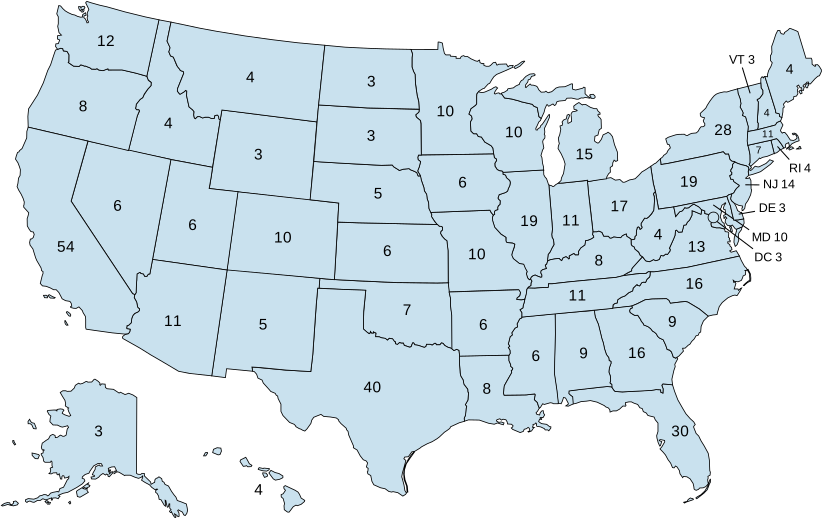
Source: Fairmind / MapChart (map), U.S. National Archives (data)3
-
All but two states award electoral votes on a winner-take-all basis. Maine and Nebraska instead award one electoral vote to the winner of each congressional district and two to the statewide winner.4
-
Modern presidential elections are commonly described as “races to 270.” Candidates compete to win enough states and congressional districts for their electoral votes to total at least 270. That is the bare majority of 538 possible electoral votes nationwide.5
-
Many opponents of the Electoral College want a national popular vote instead. Voters would directly elect the president, and the candidate with the most votes nationwide would win. This would be similar to how every U.S. state elects its governor, by popular vote within the state.6
Factors to Consider
Below are four factors to consider about the Electoral College, each with arguments from supporters and opponents. At the end of this guide, Appendix: Editorial Choices lists several factors and arguments we did not include in this main section with explanations why.
1. Inverted Elections
On four occasions (1876, 1888, 2000 and 2016), the candidate who won the most votes nationwide did not become president because another candidate won a majority of electoral votes. Political scientists often refer to these as “inverted elections.”7
Electoral College supporters argue that it’s wrong to see inverted elections as a problem. They emphasize that both sides are campaigning and spending money to win the Electoral College, not the nationwide popular-vote total. If the campaigns were pursuing the popular vote instead, they’d chase votes in places they now ignore—turning out Republicans in California, Democrats in Texas—and the total would change. Because of this, supporters argue it’s not meaningful to compare the outcome of the race actually run (the Electoral College) with a total no one was focused on winning.
National popular vote supporters often call inverted elections “wrong winner” elections. They note that almost every other significant election in the United States is won by the candidate with the most votes directly from voters. They acknowledge that campaigns would behave differently under a national popular vote, but argue that this does not answer the underlying objection: whether the rules should allow the popular-vote loser to win the election. In their view, an inverted election like 2016—when the winner received 2.9 million fewer votes than his opponent8—highlights why the answer should be no.
The key question: Are inverted elections a red flag for the Electoral College’s legitimacy, or just a quirk of nationwide vote totals that no campaign was trying to win?
2. Federalism
Federalism is the division of political power between the national government and the governments of the fifty states. The Electoral College reflects this with 51 state-level contests (one in each state and one in Washington, DC). A candidate becomes president by winning the right combination of states rather than the national popular vote.
Electoral College supporters argue that federalism naturally leads to a system where candidates must win states. They say this is what the Constitution defined—not a national popular vote—and that it has served America well for more than two hundred years. They note that a state’s electoral votes equal its House seats plus its Senate seats, so the presidential election reflects the same compromise between population and statehood that applies to Congress itself. They also note that, consistent with federalism, the Electoral College lets states choose how to allocate their electoral votes, such as through winner-take-all or district-based rules. They reject having states disregard the winners of their own contests in favor of a potentially different winner of the nationwide vote-total.
National popular vote supporters argue that although states are central to the American federal system, the president is the one elected official who represents the entire country. They therefore question why state boundaries should determine how Americans’ votes are combined when choosing that office. They note that under the Electoral College’s current practice, winner-take-all rules effectively discard the votes cast for a state’s losing candidates when electoral votes are awarded; also, the allocation of electoral votes gives residents of smaller states somewhat more representation per person.9 By comparison, they argue, a national popular vote would be fairer because every vote would count fully and equally toward the same nationwide result.
The key question: Should the president be elected through separate state contests because the United States is a federation, or should Americans vote as a single national electorate because the president represents the country as a whole?
3. Swing States
Because all but two states award their electoral votes in a winner-take-all fashion, presidential campaigns focus their efforts mainly on a small number of “swing states” where the outcome is uncertain. In contrast, “safe states” are reliably Republican or Democratic so campaigns have little incentive to spend time or resources competing for their electoral votes.
Electoral College supporters argue that a focus on swing states is good because it pushes campaigns to win over persuadable voters in a mix of states with balanced electorates. They say a national popular vote would instead let campaigns pile resources into the easiest targets: major population centers and existing supporters who just need to be convinced to turn out. In their view, this would replace one form of concentrated campaigning with another while losing the benefit of campaigns needing to appeal to voters who do not already agree with them. They add that swing states change over time,10 so the states receiving concentrated attention are not permanently fixed, and shifts in public opinion can bring new states into contention.
National popular vote supporters often argue that the focus on swing states leaves most voters on the sidelines. They note that in the 2024 presidential election, just seven states saw 94% of the candidates’ in-person events11 and nearly 80% of advertising dollars.12 They argue that under a national popular vote, campaigns would have reason to seek votes more broadly, not just in swing states. They also argue that voter participation would increase because a vote in today’s safe states would count directly toward the national result rather than having little chance of affecting the state’s electoral-vote outcome. Finally, they say that candidates would have less incentive to make special promises or post-election favors to a small set of swing states.13
The key question: What matters more: concentrating campaign attention on persuadable voters in closely divided states, or giving campaigns reason to seek votes across more of the country?
4. The NPVIC
Replacing the Electoral College outright would require a constitutional amendment. Ordinarily, that means approval by two-thirds of both chambers of Congress and ratification by 38 states.14 This makes the prospects for any constitutional amendment very challenging.
The National Popular Vote Interstate Compact (NPVIC) seeks to enable a national popular vote while working within the Electoral College, thus not requiring an amendment.15 Participating states would agree to award their electoral votes to the candidate who won the most votes nationwide, even if that candidate is different from a state’s own winner. With the NPVIC, the winner would be whoever receives the most votes nationwide, with no majority requirement.
As of September 2026, the NPVIC has 18 states and Washington, DC, representing 222 electoral votes. The compact would take effect after states totaling at least 270 electoral votes join.16 Although the NPVIC is only 48 electoral votes short, the participating jurisdictions are Democratic-leaning or Democratic-controlled.17 Reaching 270 would require the compact to expand beyond that current base, most plausibly by attracting swing states.
NPVIC opponents (who include Electoral College supporters and some national popular vote supporters) argue the amendment process exists precisely for changes like altering how the president is chosen; it deliberately requires a consensus well beyond the bare Electoral College majority the NPVIC needs. In their view, the compact is a trick to bypass this requirement. They further note that the NPVIC nationalizes the count while leaving fifty-one jurisdictions to set their own rules for who may vote, how ballots are cast, and how disputes are settled—inconsistencies currently contained within each state’s electoral votes. In contrast, an amendment could establish a national vote and the national standards for running it. NPVIC opponents add that the compact is unstable because member states retain the power to repeal their participation, whether because a new party takes control in a member state or because its voters revolt against a result that overrides their own state’s choice.18
NPVIC supporters argue the NPVIC only uses powers that states already hold. They note that the Constitution assigns the manner of appointing electors to states, which have used legislative appointment and different forms of popular election, including district allocation and winner-take-all. In supporters’ view, the NPVIC’s process would be just another way to do it, fully within states’ constitutional authority to implement. Thus, they argue the NPVIC is not an alternative to the Electoral College; it is an alternative to winner-take-all or other allocation methods within the Electoral College. On national standards, supporters answer that the current system already lets one state’s rules decide the outcome for everyone, as Florida’s did in 2000.19 As for repeal, they argue the possibility always exists when states legislate, but it is not a reason to preserve the current system.
What else to know: The NPVIC will need to handle other legal challenges on technical matters, such as whether the Constitution’s Compact Clause allows states to form the NPVIC without Congress’ consent. The NPVIC was designed with these challenges in mind, so there is at least a plausible case—but far from an assurance—that it will stand.20
The key question: Should changing how the president is elected require the broad consensus of a constitutional amendment, or should a coalition of states with an Electoral College majority be able to implement the NPVIC?
Example Viewpoints
The questions above represent genuine tensions without easy answers. Below are examples of how different people might weigh these and other considerations to arrive at coherent positions. You might find yourself aligning with one of these viewpoints, or you might form your own opinion by combining elements from multiple of them.
Electoral College Defender
The United States is a collection of states that together elect the president. The Electoral College is how we do it. In modern practice, every vote is equal within each state, then the state winners are rolled up into the Electoral College count, which is weighted by states’ congressional representation. Campaigns understand and play by those rules, so claims of the occasional “wrong winner” are misleading, referring to a different result by different rules that no one was playing by. Campaigns also understand that winning means persuading voters in closely divided states, not just turning out supporters where they’re easiest to reach. So although I am open to refinements to a system that has served the country well for more than two hundred years, I am against fundamental changes like a national popular vote—and I am particularly against the NPVIC’s attempt to end-run the constitutional process.
Constitutional Pragmatist
I understand the appeal of giving every voter equal influence nationally and ensuring that the candidate with the most votes becomes president. I also think we’ve successfully lived with the Electoral College for more than two hundred years, so I can live with it going forward. But if a national popular vote gains the broad support needed for a constitutional amendment, I would welcome that result. I especially like that an amendment could standardize eligibility, vote-counting, and recounts for the national vote—issues the NPVIC leaves hanging. The Constitution was designed to be amended when a sufficiently broad consensus exists; short of that, we should continue with the system we have.
NPVIC Advocate
“One person, one vote” should mean the same thing in a presidential election as it does in other American elections; today it does not. Look also at what the current system does to campaigns: seven states got nearly all the candidate events and most of the advertising in 2024, and tens of millions of Americans live somewhere both sides had written off before the race began. Under the National Popular Vote Interstate Compact, candidates would have reason to look for votes wherever they can find them, people in safe states would have reason to turn out, and all votes would count equally. By having states use the powers the Constitution already grants them, the NPVIC is a practical way to achieve a national vote, within the Electoral College’s framework. Waiting for an amendment that thirteen states can block is not a plan.
Deciding
The debate over the Electoral College reflects competing ideas about democracy, federalism, representation, and constitutional design. Many of the underlying facts are widely accepted, yet reasonable people continue to disagree about which values should take priority. Our goal has been to give you the facts, arguments, and a range of viewpoints to help inform your own thinking. What you decide is up to you.
(If you are wondering about something we didn’t mention, check the Editorial Choices section below. It includes other aspects of the debate we didn’t include in the main content, with explanations why.)
Appendix: Editorial Choices
In writing this guide, there were many choices to make—for example, how to frame the issue, which factors, arguments, and viewpoints to include, and how to phrase them. For those interested, below are notable choices. You can quickly scan the topics, clicking any for details.
Naming and Framing
We recognize that perceptions can be swayed by how a topic is framed and by the terminology used. In this, as with everything else in this guide, our goal is to be fair and accurate.
The Overall Question
We framed this guide’s overall question as “In U.S. presidential elections, should the Electoral College be replaced or repurposed with a national popular vote?” This reflects how the topic is most commonly debated today. We included “or repurposed” to account for the NPVIC’s method of implementing a national popular vote, which keeps the Electoral College but repurposes it to produce a winner consistent with the nationwide popular-vote total.
“National Popular Vote”
In this guide, “national popular vote” means a method of choosing the president in which the candidate who receives the most votes across the country wins. We use “nationwide popular-vote total” for the combined total obtained by adding together the results reported by the states and Washington, DC.
The distinction matters because presidential elections today are administered separately by the states and Washington, DC, under rules that can differ from one jurisdiction to another. The commonly reported nationwide figure is an aggregation of those separate totals, not the output of a single election conducted under uniform national rules.
The NPVIC would give that aggregated total decisive weight. In contrast, a constitutional amendment would establish a national popular vote together with uniform national rules for conducting it.
“Inverted Elections”
When writing in our neutral voice, we used the academic term “inverted elections” rather than the more common “wrong-winner elections.” The latter term assumes the right way to determine the winner is via a national popular vote. “Inverted elections” describes the phenomenon without assuming that either the Electoral College or the nationwide popular-vote total is the correct standard. We used “wrong-winner elections” a few times in advocates’ voices because it was more appropriate for those contexts.
Partisan Consequences
You might ask how we can cover the Electoral College debate without addressing the partisan consequences. In recent decades, the Democratic Party has tended to favor a national popular vote, and as of June 2026, the NPVIC’s current member states are Democratic-controlled or Democratic-leaning.21 The Republican Party has tended to favor retaining the Electoral College.
The reason partisan consequences aren’t in the main content is because this guide is for readers who want to form an opinion on the issue’s merits, not on which political party benefits.
As a point of information, though, it’s not obvious what the partisan consequences would be if a national popular vote were implemented. Analysts have created scores for the partisan lean of the Electoral College, which has changed over time in size and direction.22 So there is no long-term lean that would be lost. In addition, the scores were based on comparing Electoral College results to the nationwide popular-vote totals under conditions where campaigns were trying to win the Electoral College. If a national popular vote were implemented, campaigns would allocate their resources differently than if they were trying to win the Electoral College. For example, they would more aggressively pursue millions of votes in what are now Electoral College safe states. There are too many variables and uncertainties to predict whether a partisan advantage would result or which side it would favor.
Voting Power and the Small-State Bonus
Opponents sometimes raise concerns about the Electoral College’s “small-state bonus,” and its effect on the relative voting power of people in different states. The bonus comes from every state receiving two electoral votes for its Senate seats regardless of population. This allows low-population states to have more electoral votes per resident than high-population states. For example, opponents say it’s wrong that Wyoming has one electoral vote for roughly every 192,000 residents while California has one for roughly every 732,000.23
That said, the small-state bonus has a modest overall effect. After the bonus, California has 54 electoral votes compared with Wyoming’s three, and therefore still carries far more weight in the electoral count. A 2010 analysis found that if there was no small state bonus—if electoral votes had been allocated by House seats alone—the winner would have changed in only three of the 56 elections through 2008, and not consistently to one party’s benefit.24
Because the small-state bonus has only a marginal effect, we mentioned it briefly in the main content and left its details for here.
Public Opinion
For decades, a majority of Americans have favored replacing the Electoral College with a national popular vote.25 Supporters of a national popular vote often use this in their advocacy.
We did not include public opinion in the main content for a similar reason to why we didn’t include partisan consequences: because this guide is meant for readers who want to form their own opinion on the issue’s merits, not to simply follow what others want.
Contingent Elections
An unusual feature of the Electoral College is what happens if no candidate receives a majority of electoral votes. In this situation, called a “contingent election,” the election gets sent to the House of Representatives, which chooses among the three presidential candidates with the most electoral votes. Each state delegation casts a single vote, so Wyoming’s one representative and California’s 52 representatives count the same; 26 states are needed to win. Washington, DC, which has 3 electoral votes, has no vote in a contingent election. Meanwhile, the Senate separately elects the Vice President from the top two finishers, so the two offices could go to different parties. The election of 1824 was decided this way, as was the election of 1800 under somewhat different rules.26
Critics of the Electoral College say a contingent election magnifies what they already dislike about the system: the President can be chosen without regard to which candidate received the most votes nationwide. They particularly object to the one-state, one-vote system in the House, which gives some states vastly disproportionate influence in relation to their populations.
Many defenders of the Electoral College concede that the process for contingent elections would benefit from reforms, but argue the issue is not urgent because contingent elections are very unlikely to occur under current conditions. So long as nearly all states award their electoral votes on a winner-take-all basis and two major parties dominate presidential elections, one candidate will almost always reach a majority of 270 electoral votes.
The most plausible scenario for a contingent election is an exact 269–269 tie between the two leading candidates. Even in a close election like 2024, analysts at 538.com estimated the likelihood of that result at 1 in 300.27
We are noting contingent elections here rather than in the main content because the scenario is remote enough to make it a secondary consideration.
Disputed Elections
When an election is close enough for recounts, disputed ballots, or alleged irregularities to affect the outcome, the Electoral College and a national popular vote create different kinds of risks.
Supporters argue that the Electoral College is good because it contains disputes geographically. In safe states, the winning margins are usually large enough that recounts cannot plausibly change the allocation of electoral votes. A controversy in a swing state, meanwhile, stays confined to ballots and election procedures within that state, as in the Florida recount of 2000.28 Supporters say a nationally close popular vote has no such containment: every precinct in the country becomes a site of potential litigation.
Critics respond that the Electoral College invites problems by concentrating decisive votes in relatively few places. They note that the 2000 election was decided by 537 votes in Florida when the national vote difference exceeded 500,000 votes. Because a swing state has a much smaller electorate than the country as a whole, critics argue that the Electoral College makes it more likely that a very small number of disputed or miscounted votes will matter.
The trade-off comes down to this: the Electoral College has a higher chance of a relatively contained problem; a national popular vote has a lower chance of a relatively uncontained one. However, both chances are very small. Presidential elections close enough that a genuine dispute could change the results are rare, with 2000 being the only modern instance. This is distinct from the more common phenomenon of a losing candidate disputing an election without evidence of irregularities on a scale that could have changed the result.
We’ve left disputed elections to this appendix because genuinely disputable presidential elections are rare enough to make the issue secondary.
Decisiveness
Electoral College supporters sometimes argue that it has the virtue of usually producing decisive winners. Because almost every state awards its electoral votes in winner-take-all blocs, a narrow or divided popular result can end up as a lopsided electoral count. For example, Bill Clinton won 43% of the popular vote in 1992 and 69% of the electoral vote,29 helping him claim a mandate despite winning only a plurality of the popular vote. Electoral College supporters argue that a national popular vote that does not require a majority—such as the NPVIC—is a worse alternative.
This is a legitimate but secondary point. It concerns how a winner is perceived rather than the more important question of who wins, which is what this guide’s Factors to Consider turn on.
Spoilers
“Spoilers” are third-party candidates who have no chance of winning the election but whose presence—or even threatened presence—can distort the race. Advocates on both sides of the Electoral College debate say their system is better for reducing the effect of spoilers.
Electoral College supporters note that because 48 states award all their electors to the statewide winner, a candidate whose support is spread thinly across the country wins nothing: Ross Perot took 18.9% of the national vote in 1992 and not a single electoral vote.30 Supporters often describe this as the Electoral College’s moderating influence: factions too small to carry states are usually absorbed into the two major parties, where they must compromise to have any effect. Supporters contrast this with a national-popular-vote candidate worth two or three points nationally, more than the final margin in some recent presidential elections. Such a candidate could credibly threaten to run as a spoiler and cost a nominee the presidency, thereby extracting outsized political concessions.
Critics respond that the Electoral College has its own spoiler problem because decisive votes are concentrated. They cite the 2000 election as the cautionary tale. Florida was the decisive state, and Republican George W. Bush carried it by 537 votes. Third-party candidate Ralph Nader received about 97,000 votes there.31 A ballot-level analysis later estimated that Nader’s voters would have divided roughly 60–40 in Gore’s favor had Nader not run.32 Any split resembling that one would have given Gore far more than the 537 votes he needed, changing the result of the overall election.
Critics also argue that the Electoral College allows a form of spoiler leverage that a national popular vote would not. Because electors are awarded by state, a regionally concentrated candidate can win them outright. For example, George Wallace received 46 electoral votes in 1968.33 Wallace’s stated aim was to deny both major candidates a majority, then use his bloc as leverage. He hoped to have his electors support Nixon or Humphrey in exchange for policy concessions. If no deal produced an Electoral College majority, the election would have instead gone to the House of Representatives.34
All that said, it is worth keeping perspective on how often spoilers actually matter. Wallace’s 1968 plan failed, and such a maneuver would be harder today because most states now require electors to vote as pledged.35 Also, a scenario like 2000 requires a close race in a decisive state plus a third-party candidate who can attract a significant number of votes and whose supporters would clearly choose the candidate who came in second. By this standard, 2000 is the only clear case in the modern era.
So, although spoilers are a real element of the Electoral College debate, the rarity of their practical impact leaves them a secondary consideration.
More generally, it’s not obvious that a national popular vote would erode the two-party system or lead to greater third-party disruption of presidential contests. Elections that use a popular vote—such as for Congress and governor—usually end up as races between two main candidates, one a Democrat and one a Republican.
Slavery
The Electoral College emerged from several compromises reached during the Constitutional Convention of 1787. Among the most significant was the Three-Fifths Compromise, which increased Southern states’ representation in Congress by counting enslaved people as three-fifths of a person for purposes of representation.36 Because each state’s electoral votes equal its congressional representation,37 this compromise increased Southern states’ influence in presidential elections. Many historians therefore argue that slavery was an important factor in the creation and adoption of the Electoral College. For some critics, this history remains relevant today. They argue that institutions created in part to accommodate slavery deserve especially careful scrutiny before being preserved.
We chose not to include slavery in the guide’s main content because today’s supporters and opponents debate the Electoral College primarily for reasons unrelated to slavery while critics differ on how much its historical origins should influence modern judgments.
Faithless Electors
Critics sometimes cite “faithless electors” as an argument against the Electoral College. An elector is a person tasked with registering an electoral vote on behalf of a state, consistent with the outcome of that state’s election. A faithless elector votes differently. For example, in 2016 there were seven faithless electors—five pledged to Hillary Clinton and two to Donald Trump—and three more attempted to defect but had their votes rejected by their states.38 It was an unusually high number, but it was nowhere near mattering: denying Trump an Electoral College majority would have required 37 defections.39
That is the pattern across American history. Of the more than 23,000 electoral votes ever cast, 165 have been faithless.40 Faithless electors have never changed who became president.
In 2020, the Supreme Court further narrowed the risk. In Chiafalo v. Washington, the Court unanimously held that states may bind their electors and cancel or penalize a faithless vote.41 Most states and the District of Columbia now bind their electors, and a substantial minority enforce that by canceling the vote or replacing the elector.42
Because faithless electors are extremely unlikely to affect the outcome of a presidential election, we omitted discussion of them from the main content.
Other Ways to Allocate Electoral Votes
Currently, most debate about the Electoral College is about it versus a national popular vote. And many supporters of a national popular vote are focusing on the NPVIC as the best vehicle to achieve their goals.
But there are other ways to allocate electoral votes within the Electoral College.43 The main two concepts follow:
-
District allocation is how Maine and Nebraska do it. They award two electoral votes to the statewide winner and one to the winner of each congressional district.
-
Proportional allocation would divide a state’s electoral votes in proportion to candidates’ shares of the state’s popular vote.
At times in the past, different reformers have proposed making each of these allocation methods the national standard, either through a constitutional amendment or through coordinated action by the states. But today these methods have relatively few advocates. A big reason is that both methods split a state’s electoral votes, making the state less of a prize to win. Individual states are thus reluctant to act alone in devaluing their electoral votes relative to those of other states—yet it’s hard to coordinate a large enough number of states to act together at once. The main focus of this kind of coordination is currently the NPVIC.
Despite their marginal status, these alternate allocation methods are still worth noting as middle-ground options between the Electoral College’s current prevalence of winner-take-all states and a national popular vote.
Further Reading
The arguments summarized in this guide were informed by a range of writings from both supporters and opponents of the Electoral College. A web search will return many articles freely available online, usually taking one side or the other. For readers who want to explore longer, relatively balanced treatments, we recommend the following:
-
Thomas Neale, Electoral College Reform: Contemporary Issues for Congress – A 26-page paper from the Congressional Research Service that explains the background and issues around the Electoral College in an even-handed way.
-
Paul D. Schumaker and Burdett A. Loomis (editors), Choosing a President: The Electoral College and Beyond – An anthology on the Electoral College and its alternatives, written in the wake of the 2000 election controversy. 37 political scientists of different perspectives contributed. Three key chapters are freely available online: Chapter 1, Chapter 2, Chapter 12.
-
John Fortier (editor), After the People Vote: A Guide to the Electoral College, Fourth Edition – Although published by the right-leaning American Enterprise Institute, this book has argumentative essays from leading scholars on both sides of the debate. It is available in its entirety online.
-
George C. Edwards III and Gary L. Gregg II, Resolved, The Electoral College Should Be Abolished in Richard J. Ellis and Michael Nelson, Debating Reform: Conflicting Perspectives on How to Fix the American Political System – This 20-page chapter is not available for free online, but if you’re okay buying an expensive book to get it, the chapter is a relatively recent (2021) and cogent take on the debate.
Acknowledgments
Thanks to:
-
Camille Moitrier--Cadart for research assistance and input.
-
This guide’s reviewers, who brought a range of perspectives and valuable feedback.
They made this guide far better than we could have alone. Responsibility for the guide’s content rests with Fairmind.
(More about this guide’s review process)
Footnotes
-
When people vote for a presidential candidate, they are technically voting for a slate of electors pledged to that candidate. The result in each state determines which candidate’s slate of electors is chosen. Those electors then cast the votes that formally elect the president. ↩
-
Section 1 Article II of the Constitution, 23rd Amendment ↩
-
Distribution of Electoral Votes. U.S. National Archives. Accessed July 31, 2026. States’ electoral-vote counts reflect the allocation after the 2020 Census. ↩
-
Distribution of Electoral Votes. U.S. National Archives. Accessed July 31, 2026. ↩
-
In the unlikely case that no candidate achieves 270 electoral votes, the Electoral College has a process for Congress to determine the result. We cover this in the appendix’s Contingent Elections section. ↩
-
Forty-five states require only a plurality to elect their governor. The other five require a majority, with different ways of proceeding when no candidate initially has one: a popular runoff (Georgia, Louisiana and Mississippi), a vote in the legislature (Vermont), or an instant runoff from ranked-choice ballots (Alaska). Maine uses ranked-choice voting in gubernatorial primaries but elects its governor by plurality. Electoral Systems: Gubernatorial Elections. Ballotpedia. Accessed October 7, 2026. ↩
-
Michael Geruso, Dean Spears, and Ishaana Talesara. Inversions in US presidential elections: 1836–2016. American Economic Journal: Applied Economics 14, no. 1 (2022): 327–57. The 1824 election is often included in broader lists of disputed elections, but it cannot properly be called an inverted election. Andrew Jackson won the most electoral votes and the most popular votes. Because he did not win a majority of electoral votes, the election was decided by the U.S. House, where John Quincy Adams prevailed. The nationwide popular-vote total was incomplete because, at that time, several states still appointed electors without a popular election. ↩
-
Lisa Lerer. Clinton wins popular vote by nearly 2.9 million. Associated Press. December 22, 2016. ↩
-
The Electoral College’s method of allocating electoral votes to states gives extra influence to low-population states. Sometimes called the “small-state bonus,” this effect is real but has rarely made a difference in outcomes. For more, see Voting Power and the Small-State Bonus in the appendix. ↩
-
What are the current swing states, and how have they changed over time? USAFacts. Updated May 14, 2025. ↩
-
Deb Otis. Presidential campaign events in 2024. FairVote. October 31, 2024 (updated November 6, 2024). ↩
-
Domenico Montanaro. More than $10 billion has been spent on ads in the 2024 election. NPR, citing data from AdImpact. November 1, 2024. ↩
-
Studies of presidential disaster declarations and of trade actions find that battleground states and their industries are systematically favored. Evidence on federal grant spending generally is mixed. David Strömberg. The Electoral College. University of Chicago Center for Effective Government, Democracy Reform Primer Series. November 12, 2024. ↩
-
Overview of Article V, Amending the Constitution. Constitution Annotated. Library of Congress. Accessed July 31, 2026. “Ordinarily” refers to the way every constitutional amendment has been proposed. An alternate route exists: two-thirds of state legislatures could apply for a constitutional convention to propose amendments, each of which would still require ratification by three-fourths of the states. This process would avoid the need for two-thirds approval in Congress. ↩
-
The official website of the NPVIC is that of its sponsor organization, National Popular Vote. ↩
-
Agreement Among the States to Elect the President by National Popular Vote. National Popular Vote. April 14, 2026. ↩
-
“As of June 2026, all governors who had signed legislation adopting the NPVIC were members of the Democratic Party.” (National Popular Vote Interstate Compact. Ballotpedia. Accessed July 31, 2026.) ↩
-
The NPVIC does not allow states to withdraw in the run-up to and aftermath of a presidential election: if a state enacts a withdrawal on or after July 20 of an election year, it does not take effect until the next President has been inaugurated. That said, opponents argue that it’s easy to envision scenarios that would cause some member states to challenge that blackout period or, failing that, withdraw after it. For example, had the NPVIC been in force for the 2024 election, California would have needed to assign its electoral votes to Donald Trump despite the state’s own voters choosing Kamala Harris by 58% to 38%. Opponents of the NPVIC say this would have caused a huge backlash within the state, including legal challenges against the NPVIC prior to election certification and, afterward, enormous political pressure to withdraw from it. Opponents argue the same dynamic would play out across many of the compact’s other member states—all of which voted for Harris—sinking the NPVIC going forward. They argue this kind of instability should be avoided, and thus the NPVIC itself should be avoided in the first place. ↩
-
The 2000 presidential election hinged on Florida, where George W. Bush’s certified margin was 537 votes. Recounts and legal challenges involved Florida’s ballot designs, vote-counting standards, procedures, and deadlines. ↩
-
See “National Popular Vote: Legal Issues” in Thomas H. Neale and Andrew Nolan. The National Popular Vote (NPV) Initiative: Direct Election of the President by Interstate Compact. Congressional Research Service. October 25, 2018. ↩
-
“As of June 2026, all governors who had signed legislation adopting the NPVIC were members of the Democratic Party.” (National Popular Vote Interstate Compact. Ballotpedia. Accessed July 31, 2026.) ↩
-
J. Miles Coleman and Kyle Kondik. A Brief History of Electoral College Bias. The University of Virginia Center for Politics. July 6, 2023. ↩
-
United States Census Bureau. 2020 Census Apportionment Results. April 2021. See “Table 1. Apportionment Population and Number of Representatives by State: 2020 Census,” which shows state populations and U.S. House seats allocated. To get the state’s total number of electoral votes, add two to its allocated House seats. To get a state’s number of residents per electoral vote, divide its population by its number of electoral votes. ↩
-
J. Gordon Hylton, How Much Difference Does the Small State Advantage in the Electoral College Really Make? Marquette University Law School Faculty Blog. March 8, 2010. ↩
-
Jocelyn Kiley. Majority of Americans continue to favor moving away from Electoral College. Pew Research Center. September 25, 2024. ↩
-
Thomas H. Neale. Contingent Election of the President and Vice President by Congress: Perspectives and Contemporary Analysis. Congressional Research Service. November 3, 2016. ↩
-
Geoffrey Skelley, What would happen if Harris and Trump tie in the Electoral College? 538.com / ABC News. November 5, 2024. ↩
-
The 2000 presidential election hinged on Florida, where George W. Bush’s certified margin was 537 votes. Recounts and legal challenges involved Florida’s ballot designs, vote-counting standards, procedures, and deadlines. ↩
-
1992 Electoral College Results. U.S. National Archives. Accessed July 31, 2026. ↩
-
1992 Electoral College Results. U.S. National Archives. Accessed July 31, 2026. ↩
-
See “Florida” in Federal Elections 2000: Presidential General Election Results by State. Federal Elections Commission. Accessed July 31, 2026. ↩
-
Michael C. Herron and Jeffrey B. Lewis. Did Ralph Nader spoil Al Gore’s presidential bid? A ballot-level study of green and reform party voters in the 2000 presidential election. Quarterly Journal of Political Science 2, no. 3 (2007): 205-226. ↩
-
1968 Electoral College Results. U.S. National Archives. Accessed July 31, 2026. ↩
-
1968 Campaign. American Experience. Accessed July 31, 2026. ↩
-
The Electoral College. National Conference of State Legislatures. Updated August 2026. See the “Faithless Electors” section. ↩
-
Faithless Electors. FairVote. October 2024 update. See “2016 – eight Democratic electors and two Republican electors.” ↩
-
Trump was pledged 306 electors. 306 − 269 = 37. ↩
-
Faithless Electors. FairVote. October 2024 update. ↩
-
Chiafalo v. Washington. 591 U.S. 578 (2020). ↩
-
Jacob D. Shelly. Supreme Court Clarifies Rules for Electoral College: States May Restrict Faithless Electors. Congressional Research Service. July 10, 2020. ↩
-
Paul Schumaker. Analyzing the Electoral College and Its Alternatives. In Paul D. Schumaker and Burdett A. Loomis (editors). Choosing a President: The Electoral College and Beyond (New York: Chatham House Publishers, 2002). ↩
Thank you for reading! How likely are you to recommend this guide to a friend interested in the topic?
0 = Not at all likely, 10 = Extremely likely