Facts
To understand the arguments pro and con below, here are a few preliminary facts about abortion (all numbers are for the United States).
- A standard pregnancy is 40 weeks long.1 It begins with microscopic cells that develop into a tiny embryo. Around week nine, the developing organism is called a fetus and is about half an inch long (the size of a small bean). Over the remaining 31 weeks, it grows into a full-term baby. Below are the stages of fetal development.
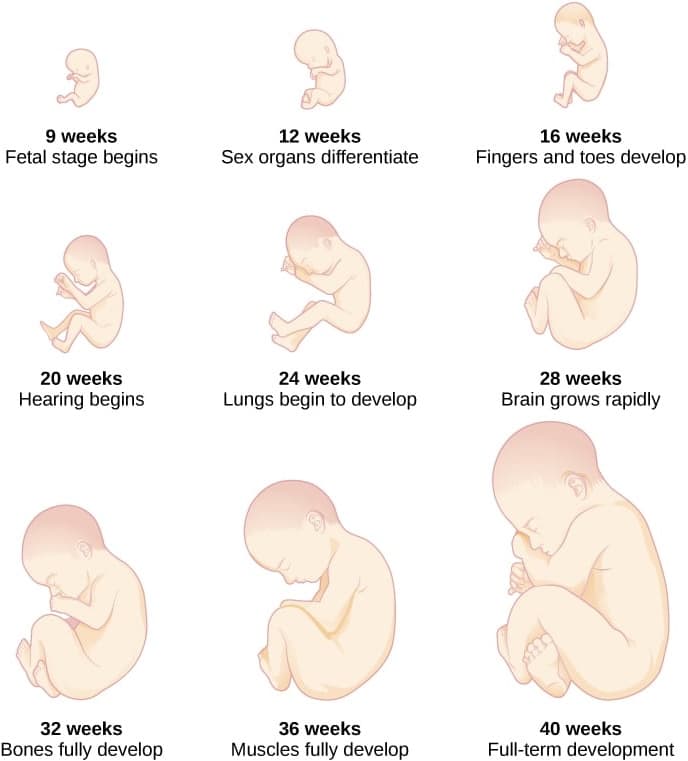
Source: BCcampus2
-
Fetus has a precise medical definition but is often used more broadly. Medically, the term refers to the developing organism after about eight weeks of pregnancy. In general usage, fetus commonly refers to the developing organism throughout pregnancy when there’s no reference to gestational age. We use the term in this broader sense unless referring to a specific stage.
-
Abortion means intentionally ending a pregnancy, stopping the process that would normally lead to childbirth. This is different from an unintentional ending of a pregnancy, commonly called a miscarriage.
-
In 2024, there were roughly one million abortions in the United States.3 For comparison, there were 3.6 million children born that year.4
-
Most abortions occur early in pregnancy. Women typically discover a pregnancy in weeks 4 to 6, although some may take several more weeks.5 Those who pursue an abortion typically do so shortly after discovering the unwanted pregnancy:
-
79% of abortions occur before week 9, during the embryonic phase.
-
92% occur by week 13, at which point the fetus is a few inches long. It is showing the beginnings of human anatomy, but its organs are still forming, and it is only about halfway to the point at which it may survive outside the pregnant woman.6
-
-
Most abortions occur at home, from clinician-prescribed pills. In 2023, 63% of abortions used such pills that cause a process medically similar to miscarriage.7 Abortions after about ten weeks typically require an in-clinic procedure that ends the pregnancy and removes the fetal remains from the uterus.8
-
Different states have different abortion laws:
-
19 states have relatively restrictive laws. 13 states have abortion bans, and 6 additional states only allow abortion up to 6 to 12 weeks, depending on the state.9
-
31 states and Washington, DC, have relatively permissive laws. These range from limits at 18 to 22 weeks, to limits at or near when the fetus is viable apart from the pregnant woman (around 24 weeks), to no time-based limits.10
-
Factors to Consider
Below are five factors to consider about the abortion debate, each with arguments from supporters and opponents. At the end of this guide, Editorial Choices lists several factors and arguments we did not include in this main section with explanations why.
1. Conflicting Rights
The abortion debate is often framed around whether—and at what point—there is a conflict of rights:
Abortion-rights supporters take different views on this question. Some argue that the fetus lacks the kind of rights that would create a conflict with the woman’s rights—a view they see as most obvious in the earliest, microscopic stage of pregnancy but not necessarily limited to that stage. Others say that even if the fetus is considered a person with a right to life, this does not justify forcing a woman to carry a pregnancy for months against her will, just as we do not force people to donate organs or make other bodily sacrifices to save others, including relatives. On either view, they say it should be the woman’s choice.
Abortion opponents often argue there is a human right to life, starting at conception. From that moment of fertilization, the newly created organism has its own unique DNA and is on a continuous path of development.11 Aborting that path, they say, means killing an innocent human being—one they see as morally comparable to a person later in life—and eliminating its future possibilities for experiences, relationships, and flourishing. They further argue that a woman’s own rights do not outweigh the obligation, unique to pregnancy, not to intentionally harm a developing human life entirely dependent on her. To them, it follows that unborn life must be protected, morally and legally.
What else to know: Some people do not believe that the relationship between the woman’s rights and the fetus’s rights is fixed. Instead, they believe the balance between those rights shifts during pregnancy. On this view, a fetus has very limited rights early on because it lacks what some see as morally relevant capacities—such as consciousness or the capacity for experience—but gains rights as those capacities develop during pregnancy. This helps explain why some people support abortion early in pregnancy but favor limits later on.
The key question: If the woman’s rights and the fetus’s rights conflict, should one always prevail, or should the balance shift as the fetus develops?
2. Fairness
Because pregnancy uniquely burdens women, abortion raises difficult questions about fairness and equal treatment for women versus men:
Abortion-rights supporters often argue that forcing women to carry unwanted pregnancies is unfair because pregnancy greatly disrupts a woman’s life, while the man typically bears far fewer of the physical, economic, and social consequences. From this perspective, access to legal abortion is seen as a way to prevent biological differences from becoming legally enforced disadvantages.
Abortion opponents often argue that while pregnancy imposes unequal burdens on women, the solution cannot be mass-scale aborting of human life. Some say society should do more to support pregnant women and mothers but any shortcomings in that support cannot justify abortion. Others argue that biological differences between men and women, including the capacity for pregnancy, are natural rather than discriminatory, and that treating those differences as injustices reflects an overly narrow view of fairness and equality.
The key question: How much weight should concerns about fairness to women carry when determining whether and how developing human life should be legally protected?
3. Drawing a Line
Most state laws draw a line during pregnancy: Before that point, abortion is generally legal; after it, abortion is restricted.
-
6 to 8 weeks. Some laws in this range restrict abortion for any case where there is detectable cardiac activity, which typically starts around 6 weeks.12 By this time, many women do not yet know they are pregnant, so critics argue these laws are more about preventing abortion than providing a practical window for it to occur.
-
12 weeks. This cutoff is used in some U.S. states and is common in much of Europe.13 Supporters see it as a point that allows most abortions (about 90%)14 while being well before later stages of pregnancy that many people associate with greater moral concern, such as when fetal movement is felt or when survival outside the womb becomes possible.
-
16 to 20 weeks. Historically, this range is when fetal movement is first felt. Before modern medicine, this was a meaningful milestone and was sometimes used in abortion law.15 It is less used today.
-
Viability (around 24 weeks). This is when a fetus may survive outside the womb with intensive medical support.16 Of states with lines drawn, viability is the most common cutoff.17 Supporters view viability as morally significant because the fetus can exist independently of the pregnant woman.
What else to know: Some states avoid drawing a line during gestation, albeit in very different ways.
-
Conception. States with abortion bans make abortion illegal at all stages of pregnancy, from conception. In addition to the moral arguments already described, some abortion opponents argue that if there is genuine uncertainty about when moral status begins, the safest course is to protect human life from the start. On this view, permitting abortion at any later point risks the wrongful taking of life, whereas protecting from conception errs on the side of caution.
-
Birth. States that allow abortion at all stages of pregnancy hold that legal personhood begins at birth. Supporters of this approach argue that women have a right to control their own bodies, and this right is not contingent on time limits during pregnancy. To those who question this for later-stage pregnancies, supporters add that such cases typically involve major medical or personal complexities best addressed by women and their doctors, not one-size-fits-all laws.
The key question: Should a line be drawn, and if so where is best?
4. Exceptions
Every state that restricts abortion has a “life of the mother” exception: If the woman’s life is endangered by the pregnancy, abortion is permitted as a medical intervention.18 This is not controversial because the death of the woman would likely also mean the death of the fetus.
If you are leaning toward an anti-abortion view, there are other exceptions to consider. Although they apply to rare situations,19 the following exceptions are part of some abortion opponents’ views:
-
Pregnancies resulting from rape or incest. Some argue that a woman should not be forced to carry a pregnancy that resulted from sexual violence or coercion. Others respond that an exception for rape and incest is not justified because the fetus is innocent and deserving protection regardless of how the pregnancy began. They acknowledge this can impose serious hardship on the pregnant woman, but they view this as less bad than ending what they see as an innocent human life.
-
Pregnancies with fatal fetal anomalies. Some people support exceptions when the fetus has profound abnormalities that are all but certain to result in death before or shortly after birth. They argue that in such cases, continuing the pregnancy will impose extreme physical and emotional burdens on the woman with no prospect of the child living a meaningful life. Those who oppose this exception argue that disability or expected short lifespan should not make a human life disposable.
-
Pregnant woman’s health. This exception goes beyond “life of the mother” to include serious but non-life-threatening medical conditions. In practice, this can include conditions that threaten permanent physical harm, worsen existing illnesses, or require medical treatment incompatible with pregnancy. Supporters argue that requiring women to wait until their lives are in immediate danger is medically unsound and ethically wrong. Opponents argue that while any exception requires physician judgment, allowing abortion for non-fatal risk invites overuse and weakens protections for fetal life.
What else to know: Some states with restrictive abortion laws support these exceptions, and some do not.20 In some cases, those opposed to the exceptions have nevertheless supported them as a political compromise, to gain enough acceptance for an anti-abortion law as a whole.
The key question: If you believe fetal life should be protected, under what circumstances, if any, should that value yield to considerations of consent, suffering, or prognosis?
5. Illegal Abortions
A final factor to consider is a practical challenge in restricting abortion: Even when abortion is illegal, many women still seek it. A 2024 study examined birth outcomes in states with abortion bans. It estimated that “roughly one-fifth to one-fourth of people seeking abortions did not receive them due to bans.”21 This suggests most women were still able to get abortions, such as by traveling to states where it is legal or obtaining mail-order abortion pills. That said, the one-fifth to one-fourth who did give birth amounted to roughly 32,000 additional annual births, which abortion opponents would characterize as lives saved.
Abortion-rights supporters often argue that an unwanted pregnancy is so disruptive to a woman’s life that most women will find ways to get an abortion even if it is illegal. Thus, supporters say, making abortion illegal mostly fails in its goal of stopping abortion, yet it makes bad situations worse for the women involved, especially those with fewer resources to work around state laws. Supporters also point to studies that show worse infant mortality22 and maternal mortality23 in states with abortion bans.
Abortion opponents often argue that anti-abortion laws matter even if many women pursue illegal abortions. To opponents, any lives saved are worthwhile, and even modest reductions in the abortion rate represent tens of thousands of lives. Further, they note laws are meant not only to deter harmful acts but also to express society’s moral judgment about what is right and wrong. In this view, abortion restrictions affirm that unborn human life deserves legal protection, even if a patchwork of state laws weakens enforcement by allowing access from less restrictive states.
The key question: If an anti-abortion law prevents some but not most abortions, does its partial deterrence and moral message justify the costs it imposes on women?
Example Viewpoints
The questions above represent genuine tensions without easy answers. Below are examples of how different people might weigh these and other considerations to arrive at coherent positions. You might find yourself aligning with one of these viewpoints, or you might form your own opinion by combining elements from multiple of them.
Near-Total Abortion Ban
I believe abortion should be illegal because it intentionally ends an innocent human life, which instead deserves protection and a chance to continue. While I recognize that pregnancy can impose serious burdens on women, I believe those burdens do not justify killing another human being. The only exception I support is when continuing the pregnancy would likely result in the mother’s death, since losing both lives would be worse. Although laws cannot prevent every abortion, any lives saved matter.
Abortion Ban with Limited Exceptions
I believe abortion is wrong in most cases and should generally be illegal. At the same time, I acknowledge that some circumstances involve extraordinary harm or injustice. For that reason, I support limited exceptions, such as in cases of rape or incest, when the fetus has fatal anomalies, or when the mother’s physical health is at serious risk. These rare situations involve exceptional moral circumstances, enough I believe to outweigh the normal right-to-life assumption. Outside of these rare and tragic cases, I believe abortion should remain illegal.
Moral Concern with Legal Doubt
It’s hard for me to justify abortion morally. I would advise anyone considering abortion to carry the pregnancy to term and choose adoption. At the same time, I recognize that I’m not the one facing an unwanted pregnancy. I accept the evidence showing that most women in that situation will seek an abortion even when it is illegal. Because of that, I can’t support laws that don’t work most of the time and that could only be made more effective by ever-more invasive policing.
Abortion Rights with Gestational Limits
I support abortion rights under most circumstances. I don’t believe an embryo has the same moral standing as a fetus much later in pregnancy. I therefore think that abortion should be legal until [insert number of weeks, 12 or more, or viability]. This reflects both the reality that most abortions occur early and the intuition that later-stage abortions of otherwise healthy pregnancies raise different moral concerns. If serious medical risks for the woman or fetus arise after the limit for legal abortion has passed, I support exceptions for those situations.
Unrestricted Abortion Rights
I believe abortion should be legal at any stage of pregnancy. Women have a fundamental right to control their own bodies, and the state should not force someone to remain pregnant against her will—even for rare cases of abortion later in pregnancy. Such situations are inevitably complex because simpler situations are handled earlier in pregnancy. That’s why it’s even more important to have women and their doctors making the decision, without government interference. Although I do not dismiss the hard choices involved, I do assert that women should be making the choices at all times.
Deciding
The abortion debate mixes questions of morals, rights, fairness, and practical effects. It’s no surprise that reasonable people reach different conclusions. Our goal has been to give you the facts, arguments, and a range of viewpoints to help inform your own thinking. What you decide is up to you.
(If you are wondering about something we didn’t mention, check the Editorial Choices section below. It includes other aspects of the debate we didn’t include in the main content, with explanations why.)
Appendix: Editorial Choices
In writing this guide, there were many choices to make—for example, how to frame the issue, which factors, arguments, and viewpoints to include, and how to phrase them. For those interested, below are notable choices. You can quickly scan the topics, clicking any for details.
Naming and Framing
We recognize that perceptions can be swayed by how a topic is framed and by the terminology used. In this, as with everything else in this guide, our goal is to be fair and accurate.
The Overall Question
We phrased the overall question for this guide as “Should abortion be legal?” because it’s the simplest way to indicate the guide is about legality.
We favored this over “Should abortion be illegal?” because questions framed as “Should _____ be illegal?” are typically asked about actions whose moral wrongness is already widely agreed, with the debate focusing on whether that wrong justifies criminal prohibition. That framing doesn’t fit abortion because the central dispute is about whether abortion is morally wrong in the first place. By contrast, “Should _____ be legal?” is more often used when the action in question is morally contested rather than broadly agreed to be wrong.
Finally, we didn’t use “Should abortion be legal or illegal” because that implies a binary choice, whereas most positions on abortion involve conditions under which it should and shouldn’t be legal.
Labels for Supporters and Opponents
We used the labels “abortion opponents” and “abortion-rights supporters.” We didn’t use the popular terms “pro-life” and “pro-choice” because they originated as persuasive framing devices—for example, the term “pro-life” implies the other side is “anti-life.”
We used “abortion-rights supporters” rather than “abortion supporters” because many people who support abortion rights believe abortion should be legal but not a preferred outcome. In contrast, “abortion opponents” typically oppose both the procedure itself and the legal right to obtain an abortion.
“Fetus” versus Other Potential Terms
When a specific developmental stage is relevant, we refer to the developing organism as an embryo or a fetus, following standard medical usage. When no stage distinction is intended, we use fetus as a general term for the developing organism during pregnancy. This broader usage is common and avoids cumbersome phrasing like “the zygote, embryo, or fetus should be protected.” Although a technical umbrella term exists—conceptus—it is obscure.
Abortion opponents sometimes use terms like unborn child, pre-born child, and baby when referring to early development. We avoided these terms because they imply that a zygote, embryo, or fetus should be regarded as equivalent to a born child—which is one of the key points of disagreement in the abortion debate.
Gender Terms
We referred to people having abortions as “pregnant women” and “women.” We did not use the term “mothers” because it implies a parental relationship, whereas many women seeking abortions do not consider themselves mothers and would reject that framing as prejudging the moral question at issue. That said, we used “life of the mother” to describe a common exception to abortion laws, because it’s the standard term.
Also, we recognize there are people who do not identify as women who can have abortions. We referred to “women” because the overwhelming majority of people seeking abortions identify as women,24 and because much of the historical and ongoing debate about abortion rights has been deeply intertwined with women’s rights. Most arguments about abortion rights and access apply regardless of gender identity.
Advocates as Data Sources
Our preference is to cite data from neutral sources. But sometimes the best data is from advocates. For example, the Guttmacher Institute is an advocacy organization for legal abortion and also the largest data collector of abortion statistics in the United States. This position was established by its historical association with Planned Parenthood, America’s largest abortion-services provider.25 Because of its comprehensiveness, Guttmacher’s data is widely used and cited by government, the media, and even by organizations that oppose abortion.26
To be clear, we are referring to Guttmacher’s data: how many abortions occur, where they occur, the demographics of who gets them, the number of weeks of gestation, and so on. This is different from Guttmacher’s policy research, which often mixes facts with advocacy.
In situations where Guttmacher’s data was the best available and was not significantly contested, we used it.
Similarly:
-
We cited an analysis from the anti-abortion Charlotte Lozier Institute because it was the best available on a particular aspect of the debate (prevalence of different types of exceptions), and the underlying data was not significantly contested.
-
We used data from the pro-abortion-rights Center for Reproductive Rights because it was the best single source of abortion-law exceptions in Europe.
Adoption as an Alternative to Abortion
Abortion opponents sometimes argue for adoption, not abortion. We did not include this argument in the main content because it has not proven to be a realistic option. A very small percentage of unwanted pregnancies end in adoption.27 The low rate of adoption isn’t due to a lack of potential adoptive families. Rather, there are several other barriers.
First, adoption does not address the physical and economic challenges of pregnancy itself. These include:
- Months of bodily disruption
- Medical costs and potential complications of pregnancy and childbirth
- Lost wages and work opportunities
Second, research shows that most women who carry a pregnancy to term develop a strong desire to parent the child themselves.28 This occurs for various reasons:
- Formation of emotional bonds during pregnancy
- Concerns about the child’s future wellbeing with unknown parents
- Feeling a personal responsibility to care for the child once they’ve carried it
- Cultural and family pressures
These factors help explain why adoption, while an important option that works well for some women, is not a common alternative to abortion for most women facing unwanted pregnancies.
Abortion and Mental Health
Both sides of the abortion debate sometimes invoke mental health in their arguments. For example:
-
Abortion opponents say women who have abortions suffer anxiety about the decision and then later, potentially over a long period of time, they experience depression and regret over the decision to abort what could have been their child.
-
Abortion rights supporters say a woman with an unwanted pregnancy is looking at many months of disruption to her life and, if keeping the child, many years of challenges for which she does not feel ready. Of course this prospect creates mental health problems. The reason so many women choose abortion is because it stops the cause of those problems, the unwanted pregnancy.
Depending on your moral intuitions about the acceptability or unacceptability of abortion, one or the other of these arguments will likely seem more common-sense to you. And individual women’s stories reveal deeply personal, often painful experiences on both sides—from those who describe lasting anguish after abortion to those who express profound relief, and many complex emotions in between.29
The core problem is differentiating between the mental-health effects of having an unwanted pregnancy versus the effects of having an abortion to end that pregnancy. The research literature has not established a consistent mental-health effect—positive or negative—attributable specifically to abortion, as distinct from the effects of an unwanted pregnancy. A widely cited comprehensive review, from a credibly neutral source, was done by the United Kingdom’s National Collaborating Centre for Mental Health in 2011. It concluded, “The rates of mental health problems for women with an unwanted pregnancy were the same whether they had an abortion or gave birth.”30
As a result, we did not include the mental-health angle in the main guide content.
Abortion’s Effect on Poverty and Crime
Some have suggested that legalized abortion has resulted in lower poverty and crime. The concept is, after abortion was legalized in the 1970s, there were fewer unwanted births, particularly among women in or near poverty, and this avoided making poverty worse than it would otherwise have been.
In a similar vein, an academic paper popularized by the bestselling book Freakonomics suggested that the rise in abortions in the 1970s was meaningfully associated with a national drop in crime in the 1990s.31 The claim was that fewer children born into high-risk situations would mean fewer criminals about twenty years later, when that generation reached the ages at which crime is most common.
We did not include abortion’s effect on poverty and crime in the main section because, in practice, few advocates use it as justification for legalized abortion. As well, it’s not clear how real or big abortion’s effect on poverty or crime is.32 Although the hypothesis is plausible, measuring it is methodologically difficult, relies on complex statistical modeling, and is sensitive to assumptions about causation, confounding factors, and counterfactuals—leading different researchers to reach different conclusions.
State Power
Abortion opponents sometimes argue that anti-abortion laws are “government overreach” or “authoritarian” because they control women’s behavior and have the potential to pry into doctors’ relationships with patients or invade other aspects of life that are normally seen as private.
We did not include this in the main section because it is in the shadow of the Conflicting Rights factor:
-
If you accept that a fetus is a human life with a right to protection, then the state’s actions—even invasive ones—are justifiable to protect life. Just as we allow the state to use surveillance and police power to prevent the killing of born persons, those who believe the fetus is a person believe the state is simply policing crime.
-
If you do not believe the fetus has the status of a person, then there’s no crime, and any state intervention is an unjustifiable invasion of privacy and other rights.
In other words, whether abortion laws represent legitimate law enforcement or unjustified state intrusion depends almost entirely on how you answer the underlying question of fetal rights.
Historical Analogies and Moral Caution
Abortion opponents sometimes argue that moral uncertainty requires taking the safest position to avoid grave wrongs. They note that history shows societies have often committed what we see today as grave wrongs such as allowing infanticide or slavery.33 In this time of moral division and uncertainty about abortion, they say, we should err on the side of protection, as those earlier societies should have.
Behind this argument is the premise that moral recognition of personhood has historically expanded—for example, to include newborn infants and enslaved people who were once denied full moral and legal status. The argument suggests that the moral circle may plausibly expand again to include the unborn. If so, permitting abortion today would place us in a position analogous to those who defended slavery or infanticide in earlier eras. The point of the argument is not certainty but caution: We should not risk being on the wrong side of history.
One complication is that there is another historical trend pointing in a different direction: the expansion of women’s rights. This includes greater legal equality, protection from abuse, and control over whether and when to have children. From this perspective, restricting abortion risks repeating past injustices in which women’s lives and choices were treated as secondary.
These two historical trends conflict when applied to abortion. Resolving the tension requires judging the relative moral weight of fetal life and women’s autonomy—the same core conflict addressed in the Conflicting Rights section. For this reason, we note the “Historical Analogies and Moral Caution” argument here but do not include it in the main section.
Public Opinion
In the United States, public opinion has favored abortion being legal in all or most cases for the past several decades, by varying amounts. For example, Pew Research has tracked the topic since 1995. During that time, the gap was as low as three percentage points in 2009 and as high as 27 points in 2024.34
In polls that ask about legality by stage of pregnancy, support drops as pregnancy progresses. For example, a 2023 poll found 73% supporting legal abortion at six weeks, 51% at fifteen weeks, and 27% at twenty-four weeks (around the time of fetal viability).35 Such results suggest that public opinion is more conditional and gradual than a single yes-or-no measure implies.
Abortion-rights advocates often highlight public support for their cause, but the majority view on a complex moral and policy issue should not be a decisive factor in forming your own position. There are multiple reasons why:
-
Independent judgment. Individual and collective wisdom comes from people making their own evaluations rather than simply following what others are saying. When we follow what’s popular because it’s popular, our views become echoes without understanding.
-
Historical error. History has shown that majorities can be wrong. Many widely accepted beliefs in the past were later widely recognized as unjust or misguided. Such changing of the collective mind cannot happen unless people are evaluating, and sometimes re-evaluating, the issues for themselves.
-
Selective reliance. Few advocates who argue based on majority support would change their position if public opinion changed. This suggests that even they recognize popularity should not be a deciding factor.
Of course, these principles apply regardless of which side currently has public opinion in its favor. Also, it’s worth noting that most polls on the topic are national, whereas abortion laws are decided state by state. Each state’s public opinion will differ from national opinion, making the national results less relevant than they might initially seem.
International Comparisons
Abortion rights supporters sometimes note that most western countries have legal abortion, although gestation limits vary. The implied argument is that these countries are the United States’ peers, and we should follow their lead.
Factually, here is the situation:
- Most European countries, Australia, New Zealand, and Canada have legal abortion with gestational limits.
- Legality in the United States and Mexico varies by state or region.
- Most countries in Africa, Asia, and South America ban abortion or permit it by exception.36
- The trend over the past fifty years has been toward countries expanding abortion legality, primarily in industrialized countries.37
Comparing different countries’ approaches can provide useful context. But abortion policy reflects deep cultural, legal, and political differences. What fits one country may not translate meaningfully to another. For example, most European countries have a gestational limit around 12 weeks.38 This would be seen as relatively restrictive in the United States, but most European countries cover abortion under national health insurance, integrate it into routine healthcare rather than specialized clinics, and have medical exceptions after the gestational limit.39 So direct comparisons are hard to make.
Ultimately, countries—and in the United States, individual states—must come to their own conclusions rather than simply follow others. For this reason, we did not include international comparisons in the main section.
Continuum with Infanticide
Abortion opponents sometimes portray abortion as part of a larger continuum with infanticide, arguing that any attempt to draw a sharp boundary will be arbitrary. For example:
Alice: You’d agree killing a one-year-old is gravely wrong, correct?
Bob: Yes, of course.
Alice: And killing a one-week old?
Bob: Yes.
Alice: A one-day-old?
Bob: That also would be gravely wrong.
Alice: Then what about aborting a healthy fetus one day before it would be born?
Bob: That also seems gravely wrong.
Alice: One week before birth?
Bob: That also seems wrong.
Alice: So where does it stop being wrong—and how do you justify that point rather than a day earlier or later?
This line of reasoning has strong intuitive force against later-stage abortions, where the fetus closely resembles a newborn. However, we did not include it in the main section because it is much weaker with respect to the vast majority of abortions, which occur early in pregnancy. If one traces the continuum back to very early stages—when the embryo is a small cluster of cells—the intuition that it is morally comparable to killing a child is far less widely shared.
This leaves the question of whether a legal line should be drawn during gestation and if so, where—a question addressed in the Drawing a Line section.
Finally, philosophers sometimes question whether birth itself marks a non-arbitrary moral boundary,40 but in law and public morality it is overwhelmingly treated as decisive, so we do not explore those debates here.
Futility of Line-Drawing
Sometimes it is argued that the act of drawing a legal line during gestation is morally futile. Critics say no matter where you pick, there is always the question of why it isn’t one day before. And if you adjust it one day before, why not one day before that?
Those who support drawing a line respond that it’s a normal thing to do in law, such as with age limits for driving or drinking. In their view, the goal cannot be to please everyone but rather to find an answer that best balances the competing interests.
We did not include the futility argument in the main section because, while it has intuitive appeal, drawing imperfect lines is a settled and unavoidable feature of law. The argument is typically raised as a philosophical puzzle rather than as a primary basis for abortion policy positions.
Prevention versus Prohibition
Some abortion-rights supporters argue that if the goal is to reduce the number of abortions, public resources should focus less on restricting abortion and more on preventing unintended pregnancies in the first place. This includes expanding access to contraception and improving sex education. The implied claim is that these approaches can reduce abortion more effectively than legal restrictions, especially given evidence that abortion bans do not stop most abortions from occurring.
This perspective faces two problems:
-
It’s not clear how much the abortion rate can be reduced by greater investment in prevention alone.41 While improved access to contraception may reduce unintended pregnancy and abortion to some extent, existing evidence suggests the size of this effect is modest rather than transformative.
-
The argument assumes prevention is an alternative to abortion restrictions, but the policy could also be implemented alongside abortion bans. If the goal is to reduce the number of abortions, this combination would be expected to perform better than either approach alone. But abortion-rights supporters would reject the combination, suggesting their primary concern is not only reducing the number of abortions but also preserving access to abortion itself—which returns the focus to the core moral and legal factors in the debate, making this a secondary consideration.
Because of these complications, we left this angle out of the main content.
Fetal Pain
Sometimes, the point at which a fetus can feel pain is raised as a moral red line—that abortion should not be permitted after that point. Although this has intuitive appeal on the surface, it has multiple problems:
-
Limited Scope. Although some abortion opponents claim fetal pain can exist as early as 12 weeks, neutral assessments put the likeliest threshold far later, well after 20 weeks,42 when 99% of abortions have already occurred.43
-
Relative Moral Weight. Logically, it’s not clear how much moral weight fetal pain carries compared to what’s causing the pain: the act of ending the fetus’ life. For most people, the moral permissibility of ending fetal life is by far the more relevant issue, regardless of whether pain is involved.
-
Practical Impact. Even if laws required anesthesia or other measures intended to prevent fetal pain, this would be unlikely to change anyone’s view about whether abortion should be legal.
For these reasons, we did not include fetal pain in the main content.
Non-Medical, Post-Viability Abortions
Abortion opponents sometimes criticize states with unrestricted abortion as allowing women to abort their healthy fetuses well after viability. They point to the existence of a small number of abortion providers nationwide that will perform post-viability abortions,44 some without requiring medical justification.45 However, the data about post-viability abortions does not clearly distinguish medical and non-medical reasons.
Defenders of later-term abortion providers say that they exist to deal with rare, complex circumstances—often medically required—and that essentially no one casually decides to abort a healthy, post-viable fetus. However, available evidence suggests that at least some post-viability abortions occur for reasons other than acute medical necessity.46 For example, a woman might discover she is pregnant unusually late, when abortion pills are no longer an option; she then takes many weeks to raise the money to pay for an in-clinic abortion, which might have the added costs and logistics of traveling out of state.
We did not cover these scenarios in the main content because they do not affect the question of abortion legality in 99%+ of cases. But if you are contemplating the Unrestricted Abortion Rights viewpoint, you need to balance its allowing a small but non-zero number of non-medical, post-viability abortions to occur versus its goal of ensuring that abortion laws do not endanger women by delaying or denying care in medically urgent situations.47
Religious Arguments
Religious beliefs—particularly those rooted in Catholic and evangelical Protestant traditions—have been a primary driver of opposition to abortion. That said, some religious communities hold official positions supporting legal abortion access.48
If this guide was about whether you personally should get an abortion, your personal religious beliefs would be key. But this guide is about a question of public policy: Should abortion be legal? In the U.S. legal system, laws are expected to be justifiable on non-religious grounds and to apply across people of different faiths or none.49
Also, as a practical matter, it is difficult to reason together in a pluralistic society when participants appeal to religious authority that others do not share. This is why even the Catholic Church makes public policy arguments about abortion in secular terms.50
Accordingly, the arguments presented in this guide are not based on any particular religious view.
Abortion and IVF (In Vitro Fertilization)
In vitro fertilization (IVF) is a fertility treatment that helps women get pregnant. It often results in the creation of extra human embryos, which may end up being destroyed.51 For abortion opponents who believe human life should be protected from conception, IVF appears to raise moral concerns similar to those posed by abortion. In both cases, early human life is being created and then not brought to term.
If you are inclined to oppose legal abortion, but are also inclined to support availability of IVF treatments, it is worth considering how to reconcile these positions. Here are some options:
-
Oppose IVF. This is the most straightforward way to maintain consistency with an anti-abortion position. But it means denying treatment to those struggling with infertility.
-
View IVF as acceptable due to its different intent from abortion. With IVF, embryos are created to help people bring new life into the world, and any loss of embryos is not the primary intent. With abortion, the primary intent is to end a pregnancy. Some argue this difference in intention makes IVF more ethically acceptable. But this view is not consistent with a central anti-abortion argument that embryos are innocent lives that should not be sacrificed regardless of the circumstances. That said, other abortion exceptions, such as for pregnancies due to rape or incest, follow a similar principle that circumstances do matter.
-
Support minimal-stimulation IVF, which uses lower doses of fertility medications to create fewer extra embryos. The downside is lower success rates and higher costs, as patients may need to undergo multiple treatment cycles.
-
Support embryo storage. This involves freezing extra embryos for future pregnancies, usually by the same parents. It allows patients to avoid creating new embryos for each pregnancy attempt, making fuller use of the embryos initially created. However, it incurs additional storage costs, and patients may not use all their frozen embryos for various reasons.
The last three options are not exclusive. They can be combined, presumably in a law that would restrict traditional IVF but allow variants that avoid or minimize embryo loss. But because the law would not provide absolute protection for human life from conception, it could be seen by some abortion opponents as morally wrong and opening the door for further compromises on key principles.
So, while IVF is not a central focus in abortion debates, it can be a useful test case for abortion opponents’ underlying beliefs about the moral status of early human life.
“Would You Want to Have Been Aborted?”
Abortion opponents sometimes pose the question, “Would you want to have been aborted?” The question is meant to highlight an apparent inconsistency: Many people who support abortion rights are glad they were born, but they support allowing abortions that will prevent others from being born.
Many abortion-rights supporters respond that this question rests on a mistaken assumption. It assumes that “you” already existed as a person at the time an abortion would have occurred. But that assumption is precisely what is disputed in the abortion debate.
One way to see this is to consider choices we generally do not view as morally wrong. Parents are not considered immoral for choosing not to have children, or for having a child at one time but not another—even though those choices determine which children exist, or whether any do at all. In those cases, there is no specific person who is harmed by not coming into existence.
If you combine this idea with a belief that an early stage fetus is not a person, then aborting that fetus is more like choosing not to conceive than like killing someone. There is no person who is made worse off by the decision. By contrast, if one believes that abortion at any stage involves killing a person, then the question naturally has force: Most people would not want to have been killed.
So, “Would You Want to Have Been Aborted?” is mostly a restatement of the underlying question in the Conflicting Rights section, about when (if ever) a fetus warrants legal protection.
“Abortion is Healthcare”
Supporters of abortion rights sometimes invoke the idea that abortion is healthcare; opponents often disagree.
On one hand, abortion can reasonably be classified as healthcare because it is a medical service provided to address a woman’s medical needs. This is true whether she receives an in-clinic procedure or takes prescribed medications under medical supervision.
On the other hand, abortion is unusual among healthcare services in its effect of ending the life of a fetus—there is no parallel with ordinary medical care. Also, unlike most medical procedures or prescriptions, abortions are often provided through specialized clinics rather than general hospitals or primary-care settings. Many healthcare organizations and individual doctors choose not to provide abortion services.
So, the implied argument of “abortion is healthcare”—that it is like other familiar and uncontroversial forms of healthcare and therefore is good—does not stand on its own. It only works if you already assume abortion is morally acceptable, which is the very question at the center of the abortion debate.
Because of this flawed reasoning, we’ve noted the argument here but left it out of the main content.
“Abortion Is Murder”
Some abortion opponents strongly believe abortion is murder while abortion-rights supporters reject the claim.
In the main part of the guide, we allowed the anti-abortion arguments to use “killing” to describe abortion because it is factually accurate to say that abortion kills a human life (a fetus being a human life but not necessarily yet a person). “Murder” did not pass that test, for a few reasons:
-
Murder means illegally and intentionally killing another person. So “abortion is murder” assumes the fetus being aborted is a person. This treats fetal personhood as a settled matter, when it is actually one of the central points of disagreement in the abortion debate.
-
Even in U.S. states where abortion is illegal, laws do not treat it like murder. Women are not held responsible, and while doctors might be punished for performing abortions, they face different penalties than they would for murder.
So, while the phrase “abortion is murder” may express the depth of some anti-abortion convictions, it is neither factually accurate nor, if taken as an argument, representative of how even anti-abortion state laws treat abortion.
Further Reading
The arguments summarized in this guide were informed by a range of writings from both supporters and opponents of abortion. A web search will return many articles freely available online, usually taking one side or the other. For readers who want to explore a book-length treatment, focused mostly on the moral questions around abortion, see Abortion Rights: For and Against (2018) by Kate Greasley and Christopher Kaczor. In it, two philosophers with opposing views on abortion present their strongest cases, then respond to each other’s points (and respond to the responses). Although written in a style that’s more conversational than academic, the substance is philosophical reasoning, so be prepared for many thought experiments, disputes about nuances, and the like.
Acknowledgments
Thanks to this guide’s reviewers, who brought a range of perspectives and valuable feedback. They made the guide far better than we could have alone. Responsibility for the guide’s content rests with Fairmind.
(More about this guide’s review process)
Footnotes
-
Medical timelines count weeks of pregnancy in a confusing way, starting from the first day of the woman’s last menstrual period. This is typically about two weeks before the sexual intercourse that leads to pregnancy; fertilization usually occurs a few days later. So when you hear, for example, “week 8,” it is actually about 6 weeks from fertilization. (Pregnancy Lingo: What Does Gestation Mean? Healthline. Updated as of July 11, 2023.) ↩
-
Image from Jessica Motherwell McFarlane. Ages, Stages, and Milestones of Development. Introduction to Psychology at BCcampus. Accessed December 21, 2025. ↩
-
The Guttmacher Institute reported 1,038,100 clinician-provided abortions in the United States in 2024. (Guttmacher Institute Releases Full-Year US Abortion Data for 2024. Guttmacher Institute. April 15, 2025.) ↩
-
Joyce A. Martin et al. Births in the United States, 2024. National Center for Health Statistics. July 2025. ↩
-
Amy M. Branum and Katherine A. Ahrens. Trends in Timing of Pregnancy Awareness Among US Women. Maternal and Child Health Journal. Volume 21, Number 4. April 2017. ↩
-
How far into pregnancy do most abortions happen? USA Facts. Updated as of June 5, 2025, referencing 2022 CDC data. ↩
-
Abortion in the United States. The Guttmacher Institute. April 2025. ↩
-
Lana Burgess. What are the different types of abortion? Medical News Today. Updated as of June 12, 2025. ↩
-
Abortion in the United States Dashboard. KFF. Updated as of November 24, 2025. ↩
-
Abortion in the United States Dashboard. KFF. Updated as of November 24, 2025. ↩
-
Jacobs reports a survey of more than 5,000 biologists, 96% of whom believed human life begins at fertilization. This is only about the question of when a human life is biologically thought to begin, not about when that life acquires rights. (Steven Andrew Jacobs. The Scientific Consensus on When Life Begins, Issues in Law & Medicine. Volume 36, Number 2. 2021. ↩
-
Proponents of laws about cardiac activity call them “heartbeat laws,” but critics argue this is misleading. They say the term “heartbeat” suggests a mature heart, whereas the activity detected at this stage reflects early cardiac development. (Jessica McDonald. When Are Heartbeats Audible During Pregnancy? FactCheck.org. July 26, 2019.) ↩
-
Tom Norton. Fact Check: Is it Harder to Get an Abortion in Europe Than America? Newsweek. May 11, 2022. ↩
-
How far into pregnancy do most abortions happen? USA Facts. Updated as of June 5, 2025, referencing 2022 CDC data. ↩
-
Historical attitudes to abortion. BBC Ethics Guide. 2014. ↩
-
Fetal Viability: The Ultimate Guide to the Legal and Medical Standard. U.S. Law Explained. Accessed December 23, 2025. ↩
-
Abortion in the United States Dashboard. KFF. Updated as of November 24, 2025. ↩
-
Mabel Felix, Laurie Sobel, and Alina Salganicoff. A Review of Exceptions in State Abortion Bans: Implications for the Provision of Abortion Services. KFF. June 6, 2024. ↩
-
Together, all the exceptions we list account for roughly 1 in 20 abortions. (Elyse Gaitan, Mia Steupert, Tessa Cox. Reasons for Abortion. Charlotte Lozier Institute, based on data from the Guttmacher Institute and individual states’ abortion reporting. Updated as of May 24, 2024.) ↩
-
KFF has a policy tracker for states with abortion bans and exceptions. As of December 19, 2025, 19 states had bans or early gestational limits (less than 13 weeks). Of these, 8 did not have a rape or incest exception, 11 did not have an exception for fatal fetal anomalies, and 6 did not have a health exception. ↩
-
Daniel Dench, Mayra Pineda-Torres, and Caitlin Myers. The effects of post-Dobbs abortion bans on fertility. Journal of Public Economics. Volume 234. June 2024. ↩
-
Alison Gemmill et al. US Abortion Bans and Infant Mortality. JAMA. Volume 333, Number 15. 2025. ↩
-
Gaia Zori et al. The relationship between state-level abortion policy and maternal mortality in the United States: a scoping review. Health Affairs Scholar. Advanced access publication, August 14, 2025. “Scoping review” indicates that the paper maps and summarizes an emerging research literature without formally weighing the quality of individual studies. Its conclusion is best read as “the current literature points in this direction,” not as a definitive judgment. ↩
-
A study by the Guttmacher Institute estimated that roughly 500 transgender and nonbinary people had abortions in the United States in 2017. That is roughly one twentieth of a percent of the total number of U.S. abortions in 2017 (in other words, 1% divided by 20). Although single studies are often not reliable—especially when estimating such tiny percentages of a population—this study has the unusual property of being based on data collected from all known facilities that provided abortion in 2017. ↩
-
Per the Guttmacher Institute’s History page: - The Guttmacher Institute was founded in 1968 as a division of Planned Parenthood. - In 1977, it became an independent nonprofit organization. - In 2007 ended its “special affiliation status” with Planned Parenthood. The institute continues to maintain data-collection relationships with essentially every abortion-services provider in the United States, many of which are affiliates of Planned Parenthood ↩
-
Paige Winfield Cunningham. Both sides of abortion debate get data from same source. The Washington Examiner. September 20, 2015. ↩
-
Various studies have estimated the number of infant adoptions at between 10,000 to 20,000 per year in the United States. Sisson endorses the high end of the range while providing citations to earlier, lower estimates. But whether 10,000 or 20,000, the amount is a tiny percentage of annual abortions, which number nearly one million. (Gretchen Sisson. Estimating the annual domestic adoption rate and lifetime incidence of infant relinquishment in the United States. Contraception. Volume 105. January 2022.) ↩
-
Lize Fuentes et al. “Adoption is just not for me”: How abortion patients in Michigan and New Mexico factor adoption into their pregnancy outcome decisions. Contraception: X. Volume 5. 2023. ↩
-
Winter writes about a range of women’s experiences with abortion. Many women describe feeling both relief and regret, sometimes simultaneously or at different times. (Meaghan Winter. My Abortion. New York. November 8, 2013.) ↩
-
Induced Abortion and Mental Health. UK National Collaborating Centre for Mental Health. December 2011. ↩
-
John J. Donohue III and Steven D. Levitt. The impact of legalized abortion on crime. The Quarterly Journal of Economics. Volume 116, Number 2. 2001. Pages 379-420. ↩
-
Clark Merrefield. Economic research resurfaces debate about the link between legalized abortion and crime reduction. The Journalist’s Resource. May 16, 2022. ↩
-
On infanticide: Richard A. Shweder et al. Abandonment and Infanticide from The Child: An Encyclopedic Companion. Chicago University Press. 2009. On slavery: Attempts to justify slavery. BBC Ethics Guide. Accessed December 16, 2025. ↩
-
Public Opinion on Abortion, Pew Research Center, updated as of June 12, 2025. ↩
-
Most Americans support legal abortion with some restrictions, AP-NORC Center for Public Affairs Research, June 2023. ↩
-
Our summary of regional differences in abortion laws is based on data from the Center for Reproductive Rights. Although it is a pro-abortion-rights advocacy organization, the Center has a long-standing, widely cited database of abortion laws worldwide. Here is their The World’s Abortion Laws map and infographic as of December 2023 ↩
-
Abortion Law: Global Comparisons, Council on Foreign Relations, updated as March 7, 2024. Note particularly the section “What have been recent trends?” ↩
-
Tom Norton. Fact Check: Is it Harder to Get an Abortion in Europe Than America? Newsweek. May 11, 2022. ↩
-
European Abortion Laws: A Comparative Overview. Center for Reproductive Rights. 2019. ↩
-
For example: Alberto Giubilini and Francesca Minerva. After-birth abortion: why should the baby live? Journal of Medical Ethics Volume 39, Issue 5. 2013. Pages 261-263. ↩
-
For example: Taehyun Kim, Daniel Marthey, Michel Boudreaux. Contraceptive access reform and abortion: Evidence from Delaware. Health Services Research. Volume 58. Issue 4. August 2023. ↩
-
Dan Levitan. Does a Fetus Feel Pain at 20 Weeks? FactCheck.org. May 18, 2015. ↩
-
How far into pregnancy do most abortions happen? USA Facts. Updated as of June 5, 2025, referencing 2022 CDC data. ↩
-
Nancy F. Berglas et al, Change in Service Availability of 2nd and 3rd Trimester Abortion Care Following Dobbs. University of California, San Francisco, Bixby Center for Global Reproductive Health. 2023. ↩
-
Monica Snyder. Pregnant at a D.C. abortion clinic. The Washington Times. August 30, 2022. ↩
-
Ivette Gomez, Alina Salganicoff, and Laurie Sobel. Abortions Later in Pregnancy in a Post-Dobbs Era. KFF. February 21, 2024. ↩
-
You might ask, “Aren’t medically urgent situations what every state’s ‘life of the mother’ exception is for?” Yes, but supporters of unrestricted abortion argue that these exceptions are often narrowly written or legally vague, leading doctors to delay care—sometimes tragically—out of fear of liability until a woman’s condition becomes extreme. From this perspective, unrestricted abortion is intended to ensure timely medical judgment rather than risk harmful delays. (Rachel Yavinsky and Mark Mather. Abortion Bans Linked to Sharp Rise in Sepsis, Infant Death, and Pregnancy-Associated Deaths, New Research Shows. Population Reference Bureau. August 7, 2025.) ↩
-
Religious Groups’ Official Positions on Abortion. Pew Research Center. January 26, 2013. ↩
-
For a historical perspective on U.S. law’s non-religious purpose and justification, see the analysis of Lemon v. Kurtzman in the U.S. Library of Congress’ Constitution Annotated. ↩
-
See Abortion is Not Healthcare by the U.S. Conference of Catholic Bishops. It is eight pages of argumentation against abortion, with no religious claims. ↩
-
Shina Caroline Lynn Kamerlin. In vitro fertilization and the ethics of frozen embryos. EMBO reports. Volume 25, Number 7. 2024. ↩
Thank you for reading! How likely are you to recommend this guide to a friend interested in the topic?
0 = Not at all likely, 10 = Extremely likely